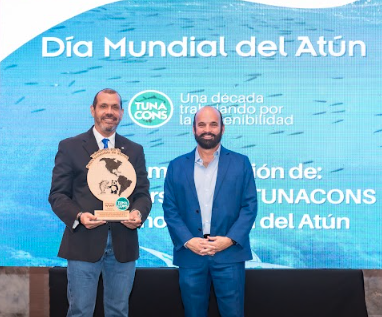
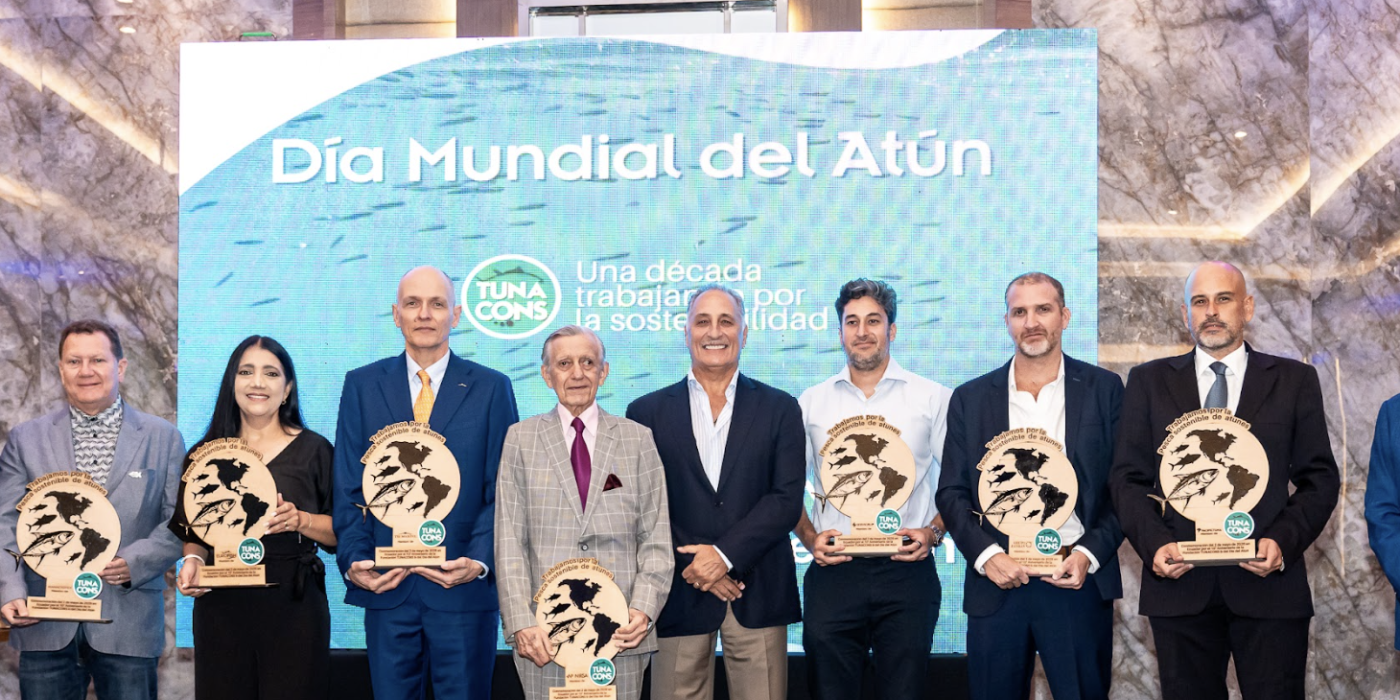
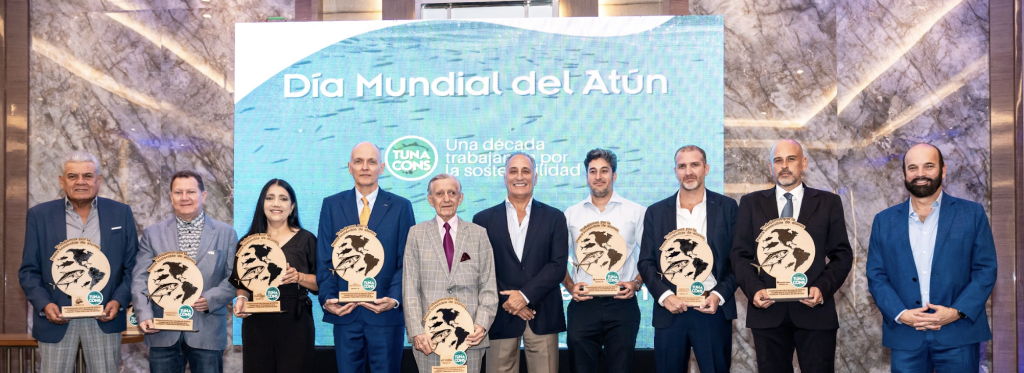
En un evento que reunió a actores clave del sector pesquero, científico e institucional, la Tuna Conservation Group (TUNACONS) celebró el doble aniversario del Día Mundial del Atún y de sus 10 años de trayectoria, destacando los avances alcanzados en sostenibilidad, ciencia, tecnología y articulación sectorial en la industria atunera.
La jornada estuvo marcada por una agenda técnica y conmemorativa que evidenció la evolución del sector en la última década. En el ámbito institucional, Guillermo Rodríguez Reyes, en representación de la autoridad pesquera ecuatoriana, resaltó el crecimiento del mercado atunero y el posicionamiento del país como referente global, subrayando el rol de la gestión pública en la consolidación de estándares de calidad e inocuidad.
Desde la ciencia, Arnulfo Franco, Director de la Comisión Interamericana del Atún Tropical (CIAT), panameño residente en San Diego, estuvo en el evento presencialmente en Ecuador y ofreció una perspectiva regional sobre el estado de las poblaciones de atunes, destacando los avances en investigación científica y el fortalecimiento de las medidas de ordenación pesquera en los últimos 10 años.
El componente tecnológico fue abordado por Idoia González, Directora Comercial Latam de Zunibal, quien expuso la evolución de herramientas como boyas satelitales, sistemas de monitoreo y digitalización de operaciones, evidenciando cómo la innovación ha transformado la eficiencia y sostenibilidad de la pesca atunera.
Por su parte, Guillermo Morán Velásquez, Director de TUNACONS, presentó una visión integral de la última década de trabajo de la organización, destacando hitos como la certificación MSC de las principales especies de atún, la implementación de programas de monitoreo y el desarrollo de iniciativas como los EcoFADs y “Cuidando Galápagos”.
El evento también puso en valor el rol de las mujeres en la industria y el crecimiento de iniciativas sostenibles impulsadas desde el sector privado.
Uno de los momentos más significativos fue la entrega de reconocimientos a las empresas miembros de TUNACONS —NIRSA, JADRAN, SERVIGRUP, EUROFISH, TRI MARINE, MANACRIPEX, MARBELIZE, PACIFICTUNA, IDELMAR, TUNAQUICK y TUNALAND— por su compromiso sostenido con la pesca responsable y la adopción de prácticas alineadas con estándares internacionales.
Asimismo, TUNACONS otorgó un reconocimiento especial a FENACOPEC, destacando a los pescadores artesanales como socios estratégicos en la construcción de una agenda común de sostenibilidad, gobernanza y mejora continua en las pesquerías del país.
En un gesto de reciprocidad, los pescadores artesanales de CORPAG, en Galápagos, entregaron un reconocimiento a TUNACONS por su apoyo técnico, acompañamiento y contribución al fortalecimiento de capacidades en territorio, evidenciando la importancia de la articulación entre el sector industrial y artesanal.
El evento concluyó con un mensaje claro: la sostenibilidad de la pesca atunera es el resultado de una década de trabajo conjunto entre industria, ciencia, autoridades y comunidades. TUNACONS reafirma así su compromiso de seguir integrando estos actores para enfrentar los desafíos futuros del sector y consolidar a Ecuador como líder en pesca responsable a nivel global.
At an event that brought together key stakeholders from the fisheries, scientific, and institutional sectors, the Tuna Conservation Group (TUNACONS) celebrated the dual anniversary of World Tuna Day and its 10-year trajectory, highlighting the progress achieved in sustainability, science, technology, and sector-wide collaboration within the tuna industry.
The event featured a technical and commemorative agenda that showcased the sector’s evolution over the past decade. From an institutional perspective, Guillermo Rodríguez Reyes, representing Ecuador’s fisheries authority, emphasized the growth of the tuna market and the country’s positioning as a global benchmark, underscoring the role of public governance in strengthening quality and food safety standards.
From the scientific front, Arnulfo Franco, Director of the Inter-American Tropical Tuna Commission (IATTC), a Panamanian based in San Diego, attended the event in person in Ecuador and provided a regional outlook on the status of tuna stocks. He highlighted advances in scientific research and the strengthening of fisheries management measures over the past 10 years.
The technological dimension was addressed by Idoia González, LatAm Commercial Director at Zunibal, who presented the evolution of tools such as satellite buoys, monitoring systems, and operational digitalization, demonstrating how innovation has transformed the efficiency and sustainability of tuna fisheries.
Guillermo Morán Velásquez, Director of TUNACONS, delivered a comprehensive overview of the organization’s work over the past decade, highlighting key milestones such as MSC certification of the main tuna species, the implementation of monitoring programs, and the development of initiatives such as EcoFADs and “Cuidando Galápagos.”
The event also highlighted the growing role of women in the industry and the expansion of sustainability initiatives driven by the private sector.
One of the most significant moments of the event was the recognition of TUNACONS member companies—NIRSA, JADRAN, SERVIGRUP, EUROFISH, TRI MARINE, MANACRIPEX, MARBELIZE, PACIFICTUNA, IDELMAR, TUNAQUICK, and TUNALAND—for their sustained commitment to responsible fishing and the adoption of practices aligned with international standards.
TUNACONS also presented a special recognition to FENACOPEC, acknowledging artisanal fishers as strategic partners in building a shared agenda for sustainability, governance, and continuous improvement in the country’s fisheries.
In a gesture of reciprocity, artisanal fishers from CORPAG in Galápagos presented a recognition to TUNACONS for its technical support, ongoing collaboration, and contribution to strengthening local capacities, highlighting the importance of alignment between the industrial and artisanal sectors.
The event concluded with a clear message: the sustainability of tuna fisheries is the result of a decade of joint efforts among industry, science, authorities, and communities. TUNACONS reaffirms its commitment to continue integrating these stakeholders to address future challenges and to further position Ecuador as a global leader in responsible fishing.
De una convicción a una plataforma de impacto Hace diez años, nació una idea impulsada por la certeza de que una pesca responsable, sostenible y basada en ciencia sí era posible. Lo que comenzó como un esfuerzo conjunto entre empresas pioneras, pronto se consolidó en una iniciativa estructurada que sentó las bases para avanzar hacia estándares internacionales como la certificación MSC.
Construyendo alianzas y bases sólidas para el cambio Desde sus inicios, el fortalecimiento de alianzas estratégicas —como la colaboración con WWF Ecuador— fue clave para impulsar el conocimiento técnico, la gobernanza y la conservación del océano. Durante estos primeros años, TUNACONS enfocó sus esfuerzos en consolidar capacidades, promover buenas prácticas y participar activamente en espacios técnicos y regulatorios que hoy definen el rumbo sostenible de la actividad.
Transparencia, monitoreo y evolución organizacional El impulso de programas de observadores a bordo y el trabajo cercano con la flota permitieron alcanzar el 100 % de cobertura, fortaleciendo la transparencia y el monitoreo. Con el tiempo, la iniciativa evolucionó hacia una organización más robusta, ampliando su alcance y consolidándose como una plataforma de articulación entre ciencia, industria, gobierno y organizaciones de conservación.
Hitos que marcaron una década de liderazgo Este proceso alcanzó logros históricos, como la certificación MSC del atún aleta amarilla en 2022, barrilete en 2023 y patudo en 2025, logrando que el 100 % de las capturas de la flota certificada cuenten con este reconocimiento. Estos hitos reflejan una década de trabajo constante, innovación y compromiso con la sostenibilidad.
Innovación y acción más allá de la certificación Paralelamente, TUNACONS ha impulsado iniciativas que amplían su impacto, como el desarrollo de EcoFADs biodegradables, programas de conservación como Cuidando Galápagos, la implementación de buenas prácticas para la liberación de especies vulnerables y acciones de economía circular como Pescando Plásticos.
Articulación para el futuro de la pesca sostenible El trabajo conjunto con autoridades y actores clave ha permitido avanzar en trazabilidad, transformación digital, control y cumplimiento normativo, fortaleciendo el ecosistema pesquero en su conjunto.
Una red que conecta ciencia, industria y conservación Hoy, TUNACONS es más que una organización: es un puente entre sectores, una voz que impulsa la sostenibilidad atunera en escenarios nacionales e internacionales, y una red de colaboración que demuestra que es posible transformar la pesca mientras se protege el océano.
El desafío continúa Este aniversario no marca un cierre, sino el inicio de una nueva etapa. Renovar la certificación MSC, consolidar la presencia en mercados sostenibles y seguir innovando serán parte del camino.
Un compromiso que sigue vivo Por el océano. Por quienes lo hacen posible. Y por el futuro de una pesca verdaderamente responsable.
From a shared conviction to a platform for impact Ten years ago, an idea was born from a clear belief: that responsible, science-based and sustainable fishing was not only possible, but necessary. What began as a joint effort among pioneering companies quickly evolved into a structured initiative, laying the groundwork to advance toward international standards such as MSC certification.
Building partnerships and strong foundations for change From the outset, strengthening strategic alliances—such as the collaboration with WWF Ecuador—proved essential to advancing technical knowledge, governance, and ocean conservation. During these early years, TUNACONS focused on building capacity, promoting best practices, and actively engaging in technical and regulatory spaces that now shape the sustainable direction of the sector.
Transparency, monitoring, and organizational evolution The implementation of onboard observer programs and close collaboration with the fleet led to 100% observer coverage, reinforcing transparency and monitoring systems. Over time, the initiative evolved into a more robust organization, expanding its reach and consolidating itself as a platform that connects science, industry, government, and conservation organizations.
Milestones that defined a decade of leadership This journey led to landmark achievements, including MSC certification for yellowfin tuna in 2022, skipjack in 2023, and bigeye in 2025—resulting in 100% of certified fleet catches meeting this standard. These milestones reflect a decade of consistent work, innovation, and commitment to sustainability.
Innovation and action beyond certification At the same time, TUNACONS has driven initiatives that extend its impact, such as the development of biodegradable EcoFADs, conservation programs like Cuidando Galápagos, the implementation of best practices for the safe release of vulnerable species, and circular economy actions such as Pescando Plásticos.
Collaboration shaping the future of sustainable fisheries Working closely with authorities and key stakeholders has enabled progress in traceability, digital transformation, monitoring, and regulatory compliance, strengthening the fisheries ecosystem as a whole.
A network connecting science, industry, and conservation Today, TUNACONS is more than an organization—it is a bridge across sectors, a voice advancing tuna sustainability at both national and international levels, and a collaborative network demonstrating that fisheries can be transformed while protecting the ocean.
The challenge continues This anniversary does not mark an end, but the beginning of a new chapter. Renewing MSC certification, strengthening market presence, and continuing to innovate will define the path ahead.
A commitment that endures For the ocean. For the people who make it possible. And for the future of truly responsible fishing.
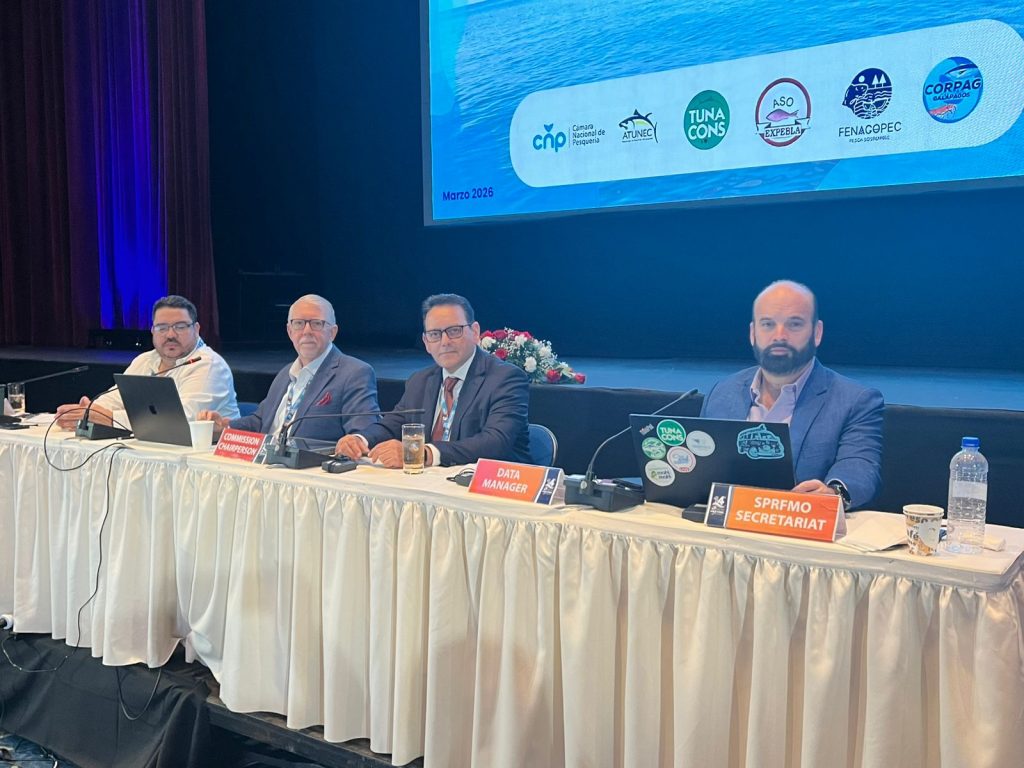
En el marco de la reunión anual de la Comisión de Pesca del Pacífico Sur, SPRFMO, realizada en la ciudad de Panamá, se llevó a cabo el evento paralelo “Tratado BBNJ y próxima PrepCom: implicaciones para la pesca en alta mar”.
Este espacio de diálogo reunió a representantes de gobiernos, especialistas en derecho del mar, organizaciones regionales y actores del sector pesquero para analizar los posibles impactos del nuevo Acuerdo sobre Biodiversidad Marina en Áreas Fuera de la Jurisdicción Nacional, conocido como BBNJ.
La sesión fue organizada por PHAFSA, la Fundación TUNACONS, la Cámara Nacional de Pesquería del Ecuador, FIPESCA y OSPESCA, con el objetivo de promover un análisis técnico y constructivo sobre los desafíos y oportunidades que plantea este nuevo instrumento internacional.
Durante el encuentro se destacó la importancia del principio de “no menoscabo”, que establece que la implementación del tratado BBNJ no debe afectar las competencias de las Organizaciones Regionales de Ordenación Pesquera, las OROP, responsables de la gestión sostenible de las pesquerías en alta mar.
El director ejecutivo de TUNACONS, Guillermo Morán Velásquez, participó en el cierre del evento, resaltando la necesidad de mantener una coordinación efectiva entre Estados, organismos regionales y sector pesquero, para asegurar que las decisiones sobre gobernanza oceánica se basen en evidencia científica y consideren también los aspectos sociales y económicos de la pesca.
El diálogo concluyó con un llamado a fortalecer la participación del sector pesquero en el proceso de implementación del BBNJ, promoviendo una gobernanza del océano que combine conservación de la biodiversidad y uso responsable de los recursos marinos.
Fisheries Sector Discusses Implications of the BBNJ Treaty During the SPRFMO Annual Meeting
Within the framework of the annual meeting of the South Pacific Regional Fisheries Management Organisation (SPRFMO), held in Panama City, the side event “BBNJ Treaty and the Upcoming PrepCom: Implications for High Seas Fisheries” was convened.
This dialogue space brought together government representatives, experts in the law of the sea, regional organizations, and stakeholders from the fisheries sector to analyze the potential impacts of the new Agreement on the Conservation and Sustainable Use of Marine Biodiversity of Areas Beyond National Jurisdiction, commonly known as BBNJ.
The session was organized by PHAFSA, the TUNACONS Foundation, the Ecuadorian National Chamber of Fisheries (CNP), FIPESCA, and OSPESCA, with the objective of promoting a technical and constructive discussion on the challenges and opportunities presented by this new international instrument.
During the meeting, participants highlighted the importance of the principle of “non-undermining,” which establishes that the implementation of the BBNJ Treaty should not affect the mandates of Regional Fisheries Management Organizations (RFMOs), which are responsible for the sustainable management of high seas fisheries.
The Executive Director of TUNACONS, Guillermo Morán Velásquez, participated in the closing of the event, emphasizing the need to maintain effective coordination among States, regional organizations, and the fisheries sector to ensure that decisions on ocean governance are based on scientific evidence and take into account the social and economic dimensions of fishing activities.
The dialogue concluded with a call to strengthen the participation of the fisheries sector in the BBNJ implementation process, promoting ocean governance that balances biodiversity conservation with the sustainable use of marine resources.
Fischereisektor diskutiert Auswirkungen des BBNJ-Abkommens während der jährlichen SPRFMO-Tagung
Im Rahmen der jährlichen Tagung der Südpazifischen Regionalen Fischereimanagementorganisation (SPRFMO), die in Panama-Stadt stattfand, wurde die Nebenveranstaltung „BBNJ-Abkommen und kommende PrepCom: Auswirkungen auf die Hochseefischerei“ durchgeführt.
Diese Dialogplattform brachte Regierungsvertreter, Experten für Seerecht, regionale Organisationen sowie Akteure des Fischereisektors zusammen, um die möglichen Auswirkungen des neuen Abkommens über die Erhaltung und nachhaltige Nutzung der marinen Biodiversität in Gebieten außerhalb nationaler Hoheitsgewalt, bekannt als BBNJ, zu analysieren.
Die Sitzung wurde von PHAFSA, der Stiftung TUNACONS, der Nationalen Fischereikammer Ecuadors (CNP), FIPESCA und OSPESCA organisiert, mit dem Ziel, eine technische und konstruktive Analyse der Herausforderungen und Chancen dieses neuen internationalen Instruments zu fördern.
Während des Treffens wurde die Bedeutung des Prinzips der „Nichtbeeinträchtigung“ hervorgehoben, das festlegt, dass die Umsetzung des BBNJ-Abkommens die Zuständigkeiten der Regionalen Fischereimanagementorganisationen (RFMOs), die für die nachhaltige Bewirtschaftung der Hochseefischerei verantwortlich sind, nicht beeinträchtigen darf.
Der Exekutivdirektor von TUNACONS, Guillermo Morán Velásquez, nahm an der Abschlussrunde der Veranstaltung teil und betonte die Notwendigkeit einer wirksamen Koordination zwischen Staaten, regionalen Organisationen und dem Fischereisektor, um sicherzustellen, dass Entscheidungen zur Meeresgovernance auf wissenschaftlicher Evidenz basieren und auch die sozialen und wirtschaftlichen Aspekte der Fischerei berücksichtigen.
Der Dialog endete mit einem Aufruf, die Beteiligung des Fischereisektors am Umsetzungsprozess des BBNJ-Abkommens zu stärken und eine Meeresgovernance zu fördern, die den Schutz der Biodiversität mit der nachhaltigen Nutzung der marinen Ressourcen in Einklang bringt.
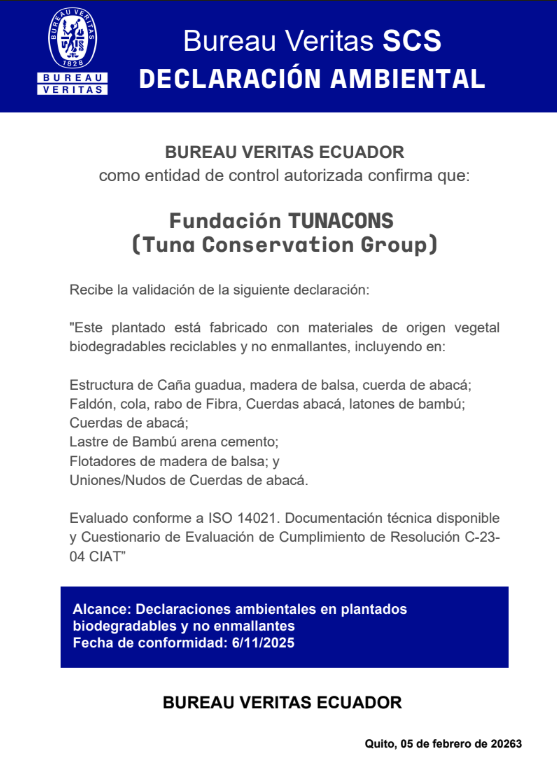
Sustainability in fisheries is not defined only by how fish are caught, but also by the technologies and devices used at sea. In this context, the TUNACONS Foundation has taken a significant step by officially validating that the fish aggregating devices (FADs) used by its fleet are manufactured exclusively with plant-based, biodegradable and non-entangling materials.
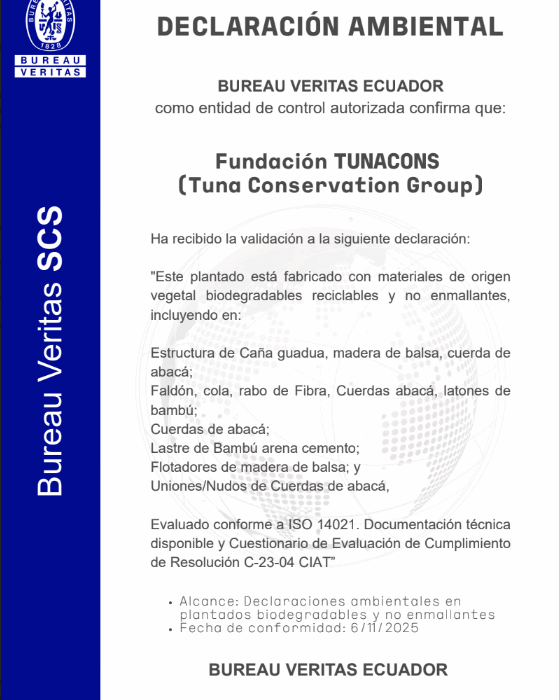
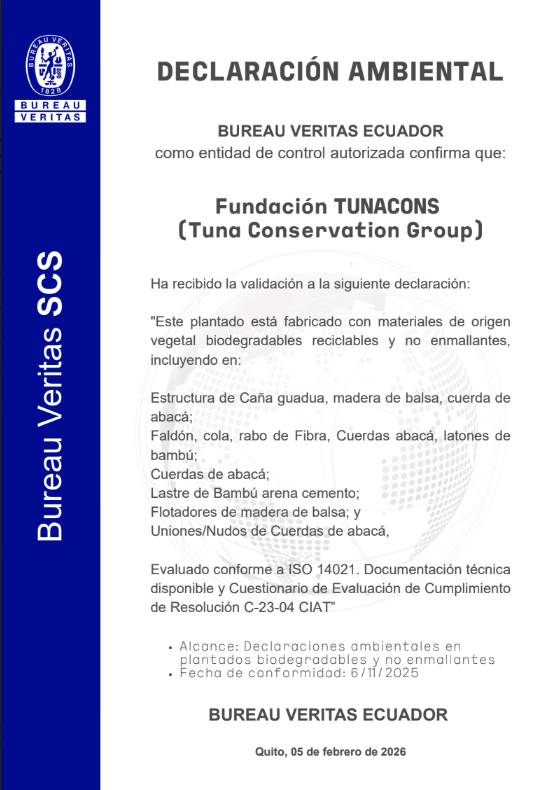
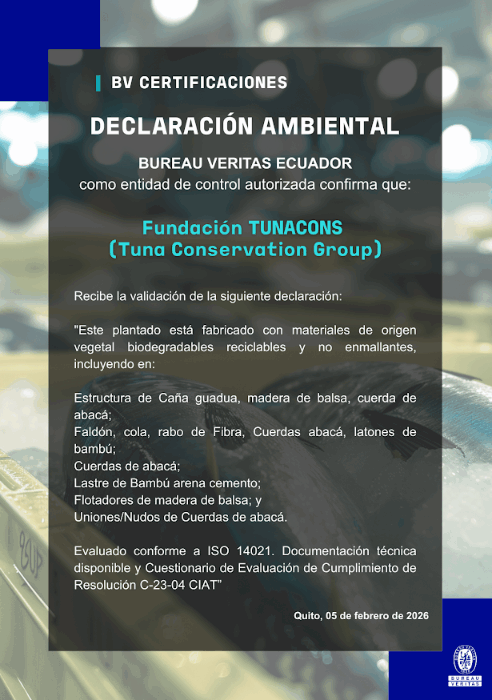
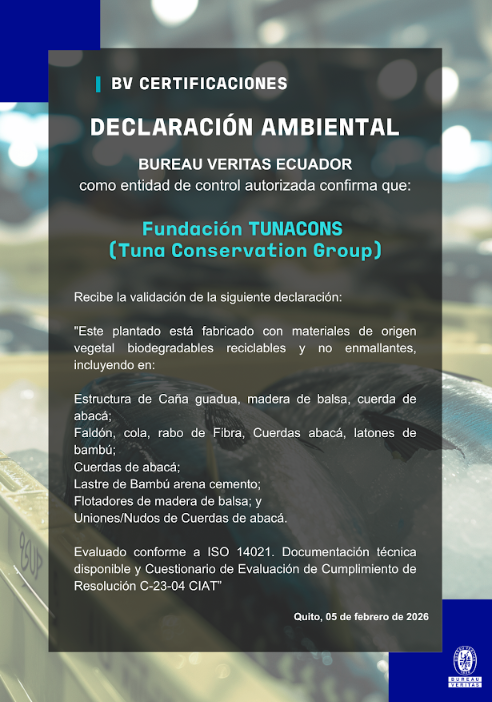
This validation was granted by Bureau Veritas Ecuador through an Environmental Declaration, following a technical evaluation process conducted in accordance with ISO 14021 and the Compliance Assessment Questionnaire of IATTC Resolution C-23-04. The assessment included a detailed review of technical documentation and verification of the materials used in the construction of the FADs.
The certified components include guadua cane, balsa wood, abacá ropes, bamboo and other natural fibers, as well as wooden floats and joining systems based on vegetal-fiber knots. These materials ensure that the FADs do not contain plastics or persistent synthetic elements, significantly reducing the risk of marine pollution, entanglement of marine fauna and long-term debris generation.
This certification reinforces TUNACONS’ commitment to continuous improvement, responsible innovation and the adoption of solutions aligned with international fisheries sustainability standards. It also provides transparency and technical traceability to the efforts of the Ecuadorian tuna sector to advance toward more responsible fishing practices that are compatible with the protection of marine ecosystems.
With this validation, TUNACONS strengthens its leadership in promoting biodegradable FADs as a concrete, verifiable tool for more sustainable tuna fisheries.
TUNACONS bestätigt: FADs bestehen aus 100 % pflanzlichen Materialien
Nachhaltigkeit in der Fischerei beschränkt sich nicht nur auf Fangmethoden, sondern umfasst auch die eingesetzten Technologien und Hilfsmittel auf See. Vor diesem Hintergrund hat die Stiftung TUNACONS einen wichtigen Schritt gemacht und offiziell bestätigt, dass die von ihrer Flotte eingesetzten Fischsammler (FADs) ausschließlich aus pflanzlichen, biologisch abbaubaren und nicht vernetzenden Materialien bestehen.
Diese Bestätigung wurde von Bureau Veritas Ecuador in Form einer Umwelterklärung ausgestellt, nachdem ein technischer Bewertungsprozess gemäß ISO 14021 sowie dem Bewertungsfragebogen zur Einhaltung der IATTC-Resolution C-23-04 durchgeführt wurde. Die Prüfung umfasste eine Analyse der technischen Dokumentation sowie die Verifizierung der verwendeten Materialien.
Zu den zertifizierten Materialien zählen Guadua-Rohr, Balsaholz, Abacá-Seile, Bambus und weitere Naturfasern sowie Schwimmkörper aus Holz und Verbindungssysteme auf Basis pflanzlicher Seilknoten. Diese Komponenten stellen sicher, dass die FADs keine Kunststoffe oder langlebigen synthetischen Materialien enthalten und tragen damit zur Reduzierung von Meeresverschmutzung, Verfangungsrisiken für Meerestiere und langfristigem Abfall bei.
Diese Zertifizierung unterstreicht das Engagement von TUNACONS für kontinuierliche Verbesserung, verantwortungsvolle Innovation und die Umsetzung von Lösungen im Einklang mit internationalen Standards für nachhaltige Fischerei. Gleichzeitig schafft sie Transparenz und technische Nachvollziehbarkeit für die Bemühungen des ecuadorianischen Thunfischsektors, nachhaltigere und umweltverträgliche Praktiken zu fördern.
Mit dieser Bestätigung festigt TUNACONS seine Vorreiterrolle bei der Förderung biologisch abbaubarer FADs als konkret überprüfbares Instrument für eine nachhaltigere Fischerei.
La sostenibilidad en la pesca no depende solo de cómo se captura el recurso, sino también de los dispositivos y tecnologías que acompañan la operación en el mar. En este contexto, la Fundación TUNACONS da un paso clave al validar oficialmente que los plantados utilizados por su flota están fabricados exclusivamente con materiales de origen vegetal, biodegradables y no enmallantes.
Esta validación fue otorgada por Bureau Veritas Ecuador mediante una Declaración Ambiental, tras un proceso de evaluación técnica conforme a la norma ISO 14021 y al Cuestionario de Evaluación de Cumplimiento de la Resolución C-23-04 de la CIAT. El proceso incluyó la revisión documental y la verificación de los componentes utilizados en la fabricación de los plantados.
Los materiales certificados incluyen caña guadua, madera de balsa, cuerdas de abacá, bambú y fibras naturales, así como flotadores de madera y sistemas de unión mediante nudos de cuerda vegetal. Estos componentes aseguran que los plantados no incorporen plásticos ni elementos sintéticos persistentes, reduciendo riesgos de contaminación marina, enmallamiento de fauna y generación de residuos a largo plazo.
Esta certificación refuerza el compromiso de TUNACONS con la mejora continua, la innovación responsable y la adopción de soluciones alineadas con los estándares internacionales de sostenibilidad pesquera. Asimismo, aporta transparencia y trazabilidad a los esfuerzos del sector atunero ecuatoriano por avanzar hacia prácticas más responsables y compatibles con la protección de los ecosistemas marinos.
Con esta validación, TUNACONS consolida su liderazgo en la promoción de plantados biodegradables como una herramienta concreta para una pesca más sostenible y técnicamente verificable.
Fundación TUNACONS has been formally accepted as a Strategic Partner of the OceanLitter Programme, a global initiative implemented by the International Maritime Organization (IMO) in collaboration with the Food and Agriculture Organization of the United Nations (FAO). The programme aims to prevent and reduce marine plastic pollution originating from maritime and fisheries-related sources.
The OceanLitter Programme supports developing countries and key maritime and fisheries stakeholders in strengthening technical, regulatory, and institutional capacities for marine litter management. Its framework is aligned with the IMO Strategy to Address Marine Plastic Litter from Ships and the FAO Voluntary Guidelines on the Marking of Fishing Gear.
TUNACONS’ incorporation as a Strategic Partner reflects its track record in implementing concrete, operational measures to prevent, reduce, and remove fisheries-related marine debris. These actions include:
– Preventive recovery of drifting or at-risk Fish Aggregating Devices (FADs), particularly in ecologically sensitive areas such as the Galápagos and other regions of the Eastern Pacific. – Development and implementation of ECOFADs constructed with plant-based materials as an alternative to conventional plastic-component devices. – Continuous application and updating of a Fisheries Best Practices Code incorporating specific marine litter prevention measures. – Programs for the management, recovery, and circular valorization of end-of-life fishing nets under circular economy schemes. – Strengthening of digital traceability systems within the associated tuna fleet.
This international partnership reinforces the role of the organized fishing sector as an active contributor to global solutions addressing marine pollution. It also enhances alignment between national initiatives and international regulatory frameworks, promoting responsible fishing gear management and continuous improvement in sustainability standards.
Through this integration, TUNACONS reaffirms its commitment to contributing technical expertise to global platforms dedicated to protecting marine ecosystems through verifiable, evidence-based action.
TUNACONS se integra como Socio Estratégico del OceanLitter Programme de FAO e IMO La Fundación
TUNACONS ha sido aceptada como Socio Estratégico del OceanLitter Programme, una iniciativa global implementada por la Organización Marítima Internacional (IMO) en alianza con la Organización de las Naciones Unidas para la Alimentación y la Agricultura (FAO), orientada a prevenir y reducir la contaminación por plásticos marinos provenientes de fuentes marítimas y pesqueras. El OceanLitter Programme trabaja con países en desarrollo y actores clave del sector marítimo y pesquero para fortalecer capacidades técnicas, regulatorias e institucionales en la gestión de la basura marina. Su enfoque se basa en la implementación de la Estrategia de la IMO para abordar la contaminación plástica desde buques y en las Directrices Voluntarias de la FAO sobre el Marcado de Artes de Pesca.
La incorporación de TUNACONS como Socio Estratégico responde a su trayectoria en la implementación de acciones concretas para prevenir, reducir y remover residuos marinos asociados a la actividad pesquera. Entre estas acciones se destacan: – Recuperación preventiva de plantados (FADs) a la deriva o con riesgo de varamiento en zonas de alta sensibilidad ecológica como Galápagos y otras áreas del Pacífico Oriental.
– Desarrollo e implementación de ECOFADs elaborados con materiales de origen vegetal, como alternativa a dispositivos convencionales con componentes plásticos.
– Aplicación y actualización continua de un Código de Buenas Prácticas Pesqueras que incorpora medidas específicas para la prevención de basura marina.
– Programas de gestión, recuperación y valorización de redes de pesca fuera de uso bajo esquemas de economía circular.
– Fortalecimiento de sistemas digitales de trazabilidad en la flota atunera asociada.
Esta alianza internacional consolida el rol del sector pesquero organizado como parte activa de la solución frente al desafío global de la contaminación marina. Asimismo, fortalece la articulación entre iniciativas nacionales y marcos regulatorios internacionales, promoviendo una gestión responsable de artes de pesca y una mejora continua en los estándares de sostenibilidad. Con esta integración, TUNACONS reafirma su compromiso de contribuir técnicamente a plataformas globales que buscan proteger los ecosistemas marinos mediante acciones verificables y basadas en evidencia.
TUNACONS wird Strategischer Partner des OceanLitter-Programms von FAO und IMO
Die Fundación TUNACONS wurde offiziell als Strategischer Partner des OceanLitter-Programms aufgenommen. Dieses globale Programm wird von der Internationalen Seeschifffahrts-Organisation (IMO) in Zusammenarbeit mit der Ernährungs- und Landwirtschaftsorganisation der Vereinten Nationen (FAO) umgesetzt und verfolgt das Ziel, die Verschmutzung der Meere durch Kunststoffe aus maritimen und fischereibezogenen Quellen zu verhindern und zu reduzieren.
Das OceanLitter-Programm unterstützt Entwicklungsländer sowie zentrale Akteure des maritimen und fischereiwirtschaftlichen Sektors beim Ausbau technischer, regulatorischer und institutioneller Kapazitäten im Bereich des Managements von Meeresmüll. Es basiert auf der IMO-Strategie zur Bekämpfung von Kunststoffabfällen aus Schiffen sowie auf den Freiwilligen Leitlinien der FAO zur Kennzeichnung von Fanggeräten.
Die Aufnahme von TUNACONS als Strategischer Partner würdigt die nachweisbare Erfahrung der Organisation bei der Umsetzung konkreter Maßnahmen zur Prävention, Reduzierung und Entfernung von fischereibedingtem Meeresmüll. Zu diesen Maßnahmen zählen:
– Präventive Bergung treibender oder strandungsgefährdeter Fischsammler (FADs), insbesondere in ökologisch sensiblen Gebieten wie Galápagos und anderen Regionen des östlichen Pazifiks. – Entwicklung und Einsatz von ECOFADs aus pflanzlichen Materialien als Alternative zu herkömmlichen Geräten mit Kunststoffkomponenten. – Kontinuierliche Anwendung und Weiterentwicklung eines Kodex für bewährte fischereiliche Praktiken mit spezifischen Maßnahmen zur Vermeidung von Meeresmüll. – Programme zur Rücknahme, Verwertung und Kreislaufführung ausgedienter Fischernetze im Rahmen von Kreislaufwirtschaftsansätzen. – Stärkung digitaler Rückverfolgbarkeitssysteme innerhalb der angeschlossenen Thunfischflotte.
Diese internationale Partnerschaft unterstreicht die Rolle des organisierten Fischereisektors als aktiver Teil der Lösung im Umgang mit der globalen Herausforderung der Meeresverschmutzung. Gleichzeitig fördert sie die Verzahnung nationaler Initiativen mit internationalen Regulierungsrahmen und unterstützt eine verantwortungsvolle Bewirtschaftung von Fanggeräten sowie die kontinuierliche Weiterentwicklung von Nachhaltigkeitsstandards.
Mit dieser Integration bekräftigt TUNACONS sein Engagement, sich mit fachlicher Expertise in globale Plattformen einzubringen, die den Schutz mariner Ökosysteme durch überprüfbare und evidenzbasierte Maßnahmen vorantreiben.
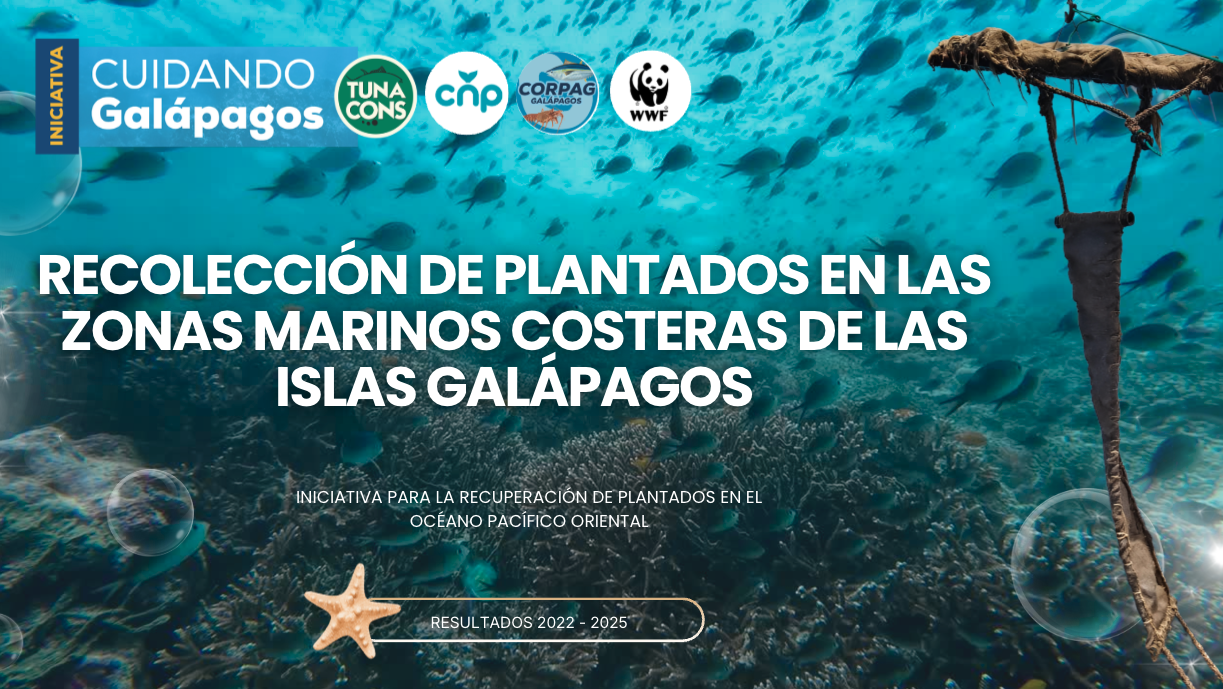
TUNACONS participated in the Second International Workshop on Fish Aggregating Device (FAD) Recovery, presenting the progress and results of its project “Collection of FADs in the Marine-Coastal Areas of the Galápagos Islands,” developed in partnership with CORPAG (the Galápagos Artisanal Fishermen Corporation), the National Chamber of Fisheries, and WWF-Ecuador.
During the international workshop, TUNACONS shared results achieved between 2022 and May 2025, highlighting that 89% of reported FADs have been successfully recovered. In total, 49 FADs were removed from the marine-coastal environment, representing nearly five metric tons of properly managed material.
The project began in 2021 with preliminary technical studies aimed at identifying areas with the highest probability of FAD arrivals or strandings within the Galápagos Marine Reserve. Based on these analyses—conducted by TUNACONS technical staff with the support of local artisanal fishers—an operational recovery model tailored to the archipelago’s conditions was designed.
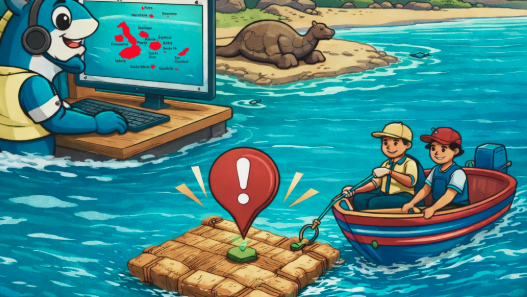
The model establishes clear coordination among vessel owners, fleet managers, island coordinators, and artisanal fishers acting as retrievers. Once a FAD is reported—providing coordinates, time of detection, and estimated drift trajectory—the recovery team mobilizes toward the potential stranding area. Throughout the operation, constant communication is maintained with the CORPAG coordinator until the device is located and secured.
After retrieval, the FAD is transported to the dock of the corresponding inhabited island. A designated receiver coordinates with the local municipality to ensure weighing, classification, recycling assessment, and final disposal in authorized secure areas. Recyclable materials are separated according to municipal guidelines, while non-recyclable components are transported to approved disposal sites.
The program includes a financial compensation mechanism recognizing the work of artisanal fishers involved in recovery operations. This mechanism is funded by TUNACONS member shipowners and administered by TUNACONS. Each operation is documented through technical forms to ensure traceability, transparency, and accountability.
To date, approximately 85 artisanal fishers have participated as FAD retrievers, strengthening collaboration between the industrial and artisanal sectors in support of marine conservation.
At the workshop, TUNACONS emphasized that this model demonstrates how multisectoral coordination, data-driven management, and shared responsibility can generate measurable environmental outcomes. The Galápagos experience offers a practical governance case aligned with regional and international efforts to reduce FAD-related impacts and prevent strandings.
Participation in this international forum reaffirms TUNACONS’ commitment to operational, measurable, and replicable solutions for responsible FAD management in the Eastern Pacific.
TUNACONS participa en el Segundo Taller Internacional sobre Recuperación de Plantados y presenta avances del programa en Galápagos
TUNACONS participó en el Segundo Taller Internacional sobre Recuperación de Dispositivos Agregadores de Peces (plantados), compartiendo los avances y resultados del proyecto “Recuperación de Plantados en las Áreas Marino-Costeras de las Islas Galápagos”, una iniciativa desarrollada en alianza con CORPAG (Corporación de Pescadores Artesanales de Galápagos), la Cámara Nacional de Pesquería y WWF-Ecuador.
Durante el encuentro internacional, TUNACONS presentó los resultados alcanzados entre 2022 y mayo de 2025, destacando que el 89% de los plantados reportados han sido recuperados exitosamente, lo que representa 49 estructuras retiradas del entorno marino-costero y cerca de cinco toneladas de material gestionado adecuadamente.
El proyecto inició en 2021 con estudios preliminares para identificar las zonas con mayor probabilidad de arribo o varamiento de plantados en la Reserva Marina de Galápagos. A partir de estos análisis técnicos, realizados por el equipo de TUNACONS con el apoyo de pescadores artesanales locales, se diseñó un modelo operativo de recuperación adaptado a la realidad territorial del archipiélago.
El modelo establece una coordinación clara entre armadores, gestores de flota, coordinadores insulares y pescadores recuperadores. Una vez reportado un plantado —incluyendo coordenadas, hora de detección y estimaciones de deriva— el equipo de recuperación se moviliza hacia la zona de posible varamiento. La operación se ejecuta en comunicación permanente con el coordinador de CORPAG hasta lograr la localización y retiro del dispositivo.
Tras la recuperación, el plantado es trasladado al muelle de la isla correspondiente, donde un receptor designado coordina con el municipio local el pesaje, clasificación y disposición final. Los materiales reciclables se separan conforme a los lineamientos municipales, mientras que los componentes no reciclables se transportan a áreas seguras autorizadas.
El programa contempla un mecanismo de reconocimiento económico para los pescadores artesanales que participan en la recuperación, financiado por armadores miembros de TUNACONS y administrado por la organización. Cada operación es documentada mediante formularios técnicos que garantizan trazabilidad, transparencia y rendición de cuentas.
Hasta la fecha, aproximadamente 85 pescadores artesanales han participado como recuperadores de plantados, fortaleciendo la colaboración entre el sector industrial y el artesanal en favor de la conservación marina.
En el taller internacional, TUNACONS destacó que este modelo demuestra cómo la coordinación multisectorial, la gestión basada en datos y la corresponsabilidad pueden traducirse en resultados ambientales concretos. La experiencia de Galápagos aporta un caso práctico de gobernanza colaborativa para la gestión de plantados, alineado con los esfuerzos regionales e internacionales para reducir impactos y prevenir varamientos.
La participación de TUNACONS en este espacio reafirma su compromiso con soluciones operativas, medibles y replicables para la gestión responsable de plantados en el Pacífico Oriental.
–
TUNACONS nimmt am Zweiten Internationalen Workshop zur Bergung von Fischsammlern teil und präsentiert Fortschritte aus dem Galápagos-Programm
TUNACONS nahm am Zweiten Internationalen Workshop zur Bergung von Fischsammlern (FADs) teil und stellte die Fortschritte seines Projekts „Bergung von FADs in den marinen Küstengebieten der Galápagos-Inseln“ vor. Das Projekt wird in Partnerschaft mit CORPAG (Vereinigung der handwerklichen Fischer von Galápagos), der Nationalen Fischereikammer sowie WWF-Ecuador umgesetzt.
Im Rahmen der Veranstaltung präsentierte TUNACONS die Ergebnisse aus dem Zeitraum 2022 bis Mai 2025. Dabei wurde hervorgehoben, dass 89 % der gemeldeten FADs erfolgreich geborgen werden konnten. Insgesamt wurden 49 FADs aus dem marinen Küstenumfeld entfernt, was nahezu fünf Tonnen sachgerecht entsorgtes Material entspricht.
Das Projekt startete 2021 mit technischen Vorstudien zur Identifizierung von Gebieten mit erhöhter Wahrscheinlichkeit für das Anlanden oder Stranden von FADs innerhalb des Galápagos-Meeresschutzgebiets. Auf Grundlage dieser Analysen, durchgeführt durch das technische Team von TUNACONS mit Unterstützung lokaler handwerklicher Fischer, wurde ein operatives Bergungsmodell entwickelt, das an die besonderen Bedingungen des Archipels angepasst ist.
Das Modell definiert klare Koordinationsmechanismen zwischen Schiffseignern, Flottenmanagern, Inselkoordinatoren und handwerklichen Fischern als Bergungsteams. Nach Meldung eines FADs – einschließlich Koordinaten, Meldezeitpunkt und geschätzter Driftbewegung – wird das Bergungsteam in das potenzielle Strandungsgebiet entsandt. Während des gesamten Einsatzes erfolgt eine kontinuierliche Abstimmung mit dem CORPAG-Koordinator bis zur erfolgreichen Lokalisierung und Sicherung des Geräts.
Nach der Bergung wird der FAD zum Hafen der jeweiligen bewohnten Insel transportiert. Ein benannter Ansprechpartner koordiniert mit der zuständigen Gemeindeverwaltung das Wiegen, die Klassifizierung, die Prüfung auf Recyclingfähigkeit sowie die endgültige Entsorgung in genehmigten sicheren Bereichen. Recyclingfähige Materialien werden gemäß kommunalen Vorgaben getrennt, nicht recyclingfähige Komponenten werden ordnungsgemäß entsorgt.
Das Programm beinhaltet zudem einen finanziellen Ausgleich für die beteiligten handwerklichen Fischer, finanziert durch Mitgliedsreeder von TUNACONS und administriert durch die Organisation. Jede Bergung wird durch technische Formulare dokumentiert, um Rückverfolgbarkeit, Transparenz und Rechenschaftspflicht sicherzustellen.
Bis heute haben rund 85 handwerkliche Fischer an den Bergungsmaßnahmen teilgenommen und damit die Zusammenarbeit zwischen industriellem und handwerklichem Sektor im Sinne des Meeresschutzes gestärkt.
Auf dem Workshop betonte TUNACONS, dass dieses Modell zeigt, wie sektorübergreifende Koordination, datenbasierte Steuerung und gemeinsame Verantwortung zu messbaren Umweltwirkungen führen können. Die Erfahrung aus Galápagos stellt ein praxisnahes Governance-Beispiel dar, das sich in regionale und internationale Bemühungen zur Reduzierung von FAD-bedingten Auswirkungen einfügt.
Die Teilnahme an diesem internationalen Forum bekräftigt das Engagement von TUNACONS für operative, messbare und übertragbare Lösungen im verantwortungsvollen FAD-Management im östlichen Pazifik.
Sustainable fisheries management is defined not only by what is caught, but also by the decisions made on deck in critical moments. Today we highlight an action that often goes unseen, yet speaks volumes about our fleet’s commitment: the safe release of vulnerable species, including silky sharks.
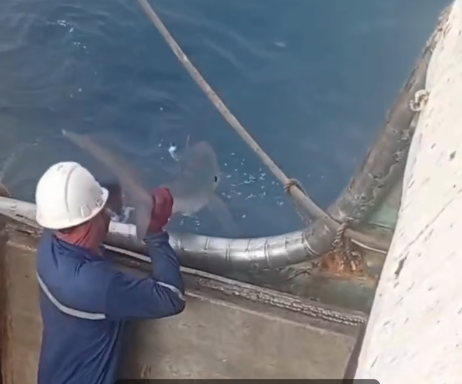
Each release involves trained crew members and onboard observers applying technical criteria, established handling protocols, and best practices for safe release. The objective is clear: minimize stress, reduce injury, and ensure the animal’s return to the ocean in optimal condition.
These procedures represent real-time responsible management — rapid decision-making, coordinated deck operations, and compliance with scientific guidance and regulatory frameworks. This is where sustainability shifts from concept to operational practice.
We acknowledge the crews of the vessels Betty Elizabeth, Ignacio Mar I, and Southern Queen, along with their onboard observers, for properly executing these measures and demonstrating that responsible fishing begins at sea.
At TUNACONS, sustainability is not rhetoric. It is implemented through daily operational discipline and a firm commitment to ecosystem protection.
Lo que no siempre se ve, pero lo dice todo: liberación responsable de especies vulnerables
La sostenibilidad pesquera no se define únicamente por las capturas, sino también por las decisiones que se toman en segundos a bordo. Hoy destacamos una acción que muchas veces no se ve, pero que refleja el compromiso real de nuestra flota: la liberación segura de especies vulnerables, incluyendo tiburón sedoso.
En cada maniobra intervienen tripulantes capacitados y observadores a bordo que aplican criterios técnicos, protocolos claros y buenas prácticas de manipulación y liberación. El objetivo es reducir el estrés del animal, minimizar lesiones y asegurar su retorno al mar en las mejores condiciones posibles.
Estas acciones forman parte de una gestión responsable en tiempo real: decisiones rápidas, coordinación en cubierta y cumplimiento de lineamientos científicos y regulatorios. Es allí donde la sostenibilidad deja de ser un concepto y se convierte en operación concreta.
Reconocemos el trabajo de los buques Betty Elizabeth, Ignacio Mar I y Southern Queen, junto a sus observadores a bordo, por ejecutar correctamente estos procedimientos y demostrar que la pesca responsable se construye desde la flota, todos los días.
En TUNACONS, la sostenibilidad no es discurso. Se opera en cada lance, en cada decisión y en cada liberación que protege el ecosistema marino.
Was nicht immer sichtbar ist – aber alles aussagt: Verantwortungsvolle Freilassung gefährdeter Arten
Nachhaltige Fischerei wird nicht nur durch Fänge definiert, sondern auch durch die Entscheidungen, die in entscheidenden Momenten an Bord getroffen werden. Heute heben wir eine Maßnahme hervor, die häufig im Hintergrund bleibt, jedoch die Verantwortung unserer Flotte deutlich macht: die sachgerechte Freilassung gefährdeter Arten, darunter der Seidenhai.
Bei jeder Freilassung arbeiten geschulte Besatzungsmitglieder und Beobachter an Bord nach klaren technischen Vorgaben und bewährten Handhabungs- und Freilassungsprotokollen. Ziel ist es, Stress zu minimieren, Verletzungen zu vermeiden und eine möglichst schonende Rückführung ins Meer sicherzustellen.
Diese Maßnahmen stehen für verantwortungsvolles Management in Echtzeit: schnelle Entscheidungen, koordinierte Abläufe an Deck und die Einhaltung wissenschaftlicher sowie regulatorischer Vorgaben. Hier wird Nachhaltigkeit zur operativen Praxis.
Wir würdigen die Besatzungen der Schiffe Betty Elizabeth, Ignacio Mar I und Southern Queen sowie ihre Beobachter an Bord für die korrekte Umsetzung dieser Verfahren und ihren Beitrag zum Schutz mariner Ökosysteme.
Bei TUNACONS ist Nachhaltigkeit kein Schlagwort, sondern tägliche betriebliche Verantwortung auf See.