Sustainability in fisheries is not defined only by how fish are caught, but also by the technologies and devices used at sea. In this context, the TUNACONS Foundation has taken a significant step by officially validating that the fish aggregating devices (FADs) used by its fleet are manufactured exclusively with plant-based, biodegradable and non-entangling materials.
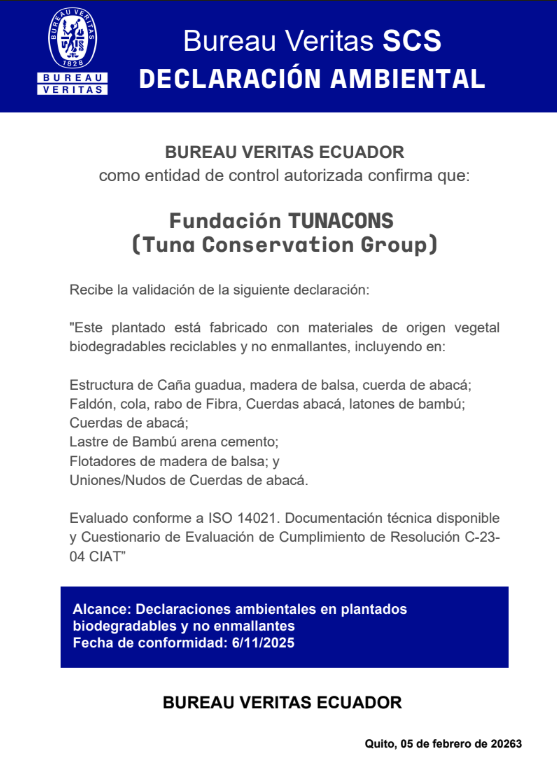
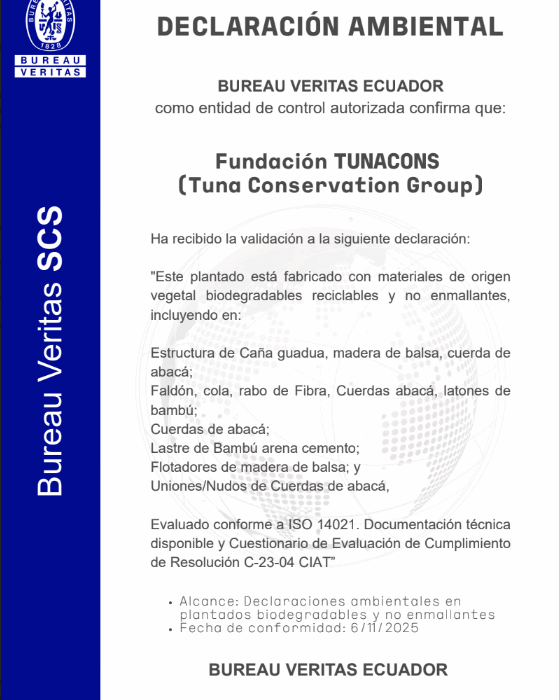
This validation was granted by Bureau Veritas Ecuador through an Environmental Declaration, following a technical evaluation process conducted in accordance with ISO 14021 and the Compliance Assessment Questionnaire of IATTC Resolution C-23-04. The assessment included a detailed review of technical documentation and verification of the materials used in the construction of the FADs.
The certified components include guadua cane, balsa wood, abacá ropes, bamboo and other natural fibers, as well as wooden floats and joining systems based on vegetal-fiber knots. These materials ensure that the FADs do not contain plastics or persistent synthetic elements, significantly reducing the risk of marine pollution, entanglement of marine fauna and long-term debris generation.
This certification reinforces TUNACONS’ commitment to continuous improvement, responsible innovation and the adoption of solutions aligned with international fisheries sustainability standards. It also provides transparency and technical traceability to the efforts of the Ecuadorian tuna sector to advance toward more responsible fishing practices that are compatible with the protection of marine ecosystems.
With this validation, TUNACONS strengthens its leadership in promoting biodegradable FADs as a concrete, verifiable tool for more sustainable tuna fisheries.
TUNACONS bestätigt: FADs bestehen aus 100 % pflanzlichen Materialien
Nachhaltigkeit in der Fischerei beschränkt sich nicht nur auf Fangmethoden, sondern umfasst auch die eingesetzten Technologien und Hilfsmittel auf See. Vor diesem Hintergrund hat die Stiftung TUNACONS einen wichtigen Schritt gemacht und offiziell bestätigt, dass die von ihrer Flotte eingesetzten Fischsammler (FADs) ausschließlich aus pflanzlichen, biologisch abbaubaren und nicht vernetzenden Materialien bestehen.
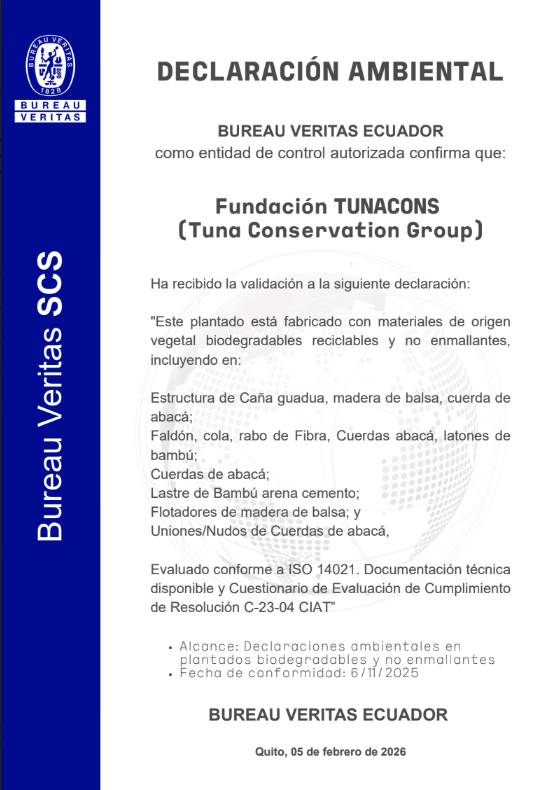
Diese Bestätigung wurde von Bureau Veritas Ecuador in Form einer Umwelterklärung ausgestellt, nachdem ein technischer Bewertungsprozess gemäß ISO 14021 sowie dem Bewertungsfragebogen zur Einhaltung der IATTC-Resolution C-23-04 durchgeführt wurde. Die Prüfung umfasste eine Analyse der technischen Dokumentation sowie die Verifizierung der verwendeten Materialien.
Zu den zertifizierten Materialien zählen Guadua-Rohr, Balsaholz, Abacá-Seile, Bambus und weitere Naturfasern sowie Schwimmkörper aus Holz und Verbindungssysteme auf Basis pflanzlicher Seilknoten. Diese Komponenten stellen sicher, dass die FADs keine Kunststoffe oder langlebigen synthetischen Materialien enthalten und tragen damit zur Reduzierung von Meeresverschmutzung, Verfangungsrisiken für Meerestiere und langfristigem Abfall bei.
Diese Zertifizierung unterstreicht das Engagement von TUNACONS für kontinuierliche Verbesserung, verantwortungsvolle Innovation und die Umsetzung von Lösungen im Einklang mit internationalen Standards für nachhaltige Fischerei. Gleichzeitig schafft sie Transparenz und technische Nachvollziehbarkeit für die Bemühungen des ecuadorianischen Thunfischsektors, nachhaltigere und umweltverträgliche Praktiken zu fördern.
Mit dieser Bestätigung festigt TUNACONS seine Vorreiterrolle bei der Förderung biologisch abbaubarer FADs als konkret überprüfbares Instrument für eine nachhaltigere Fischerei.