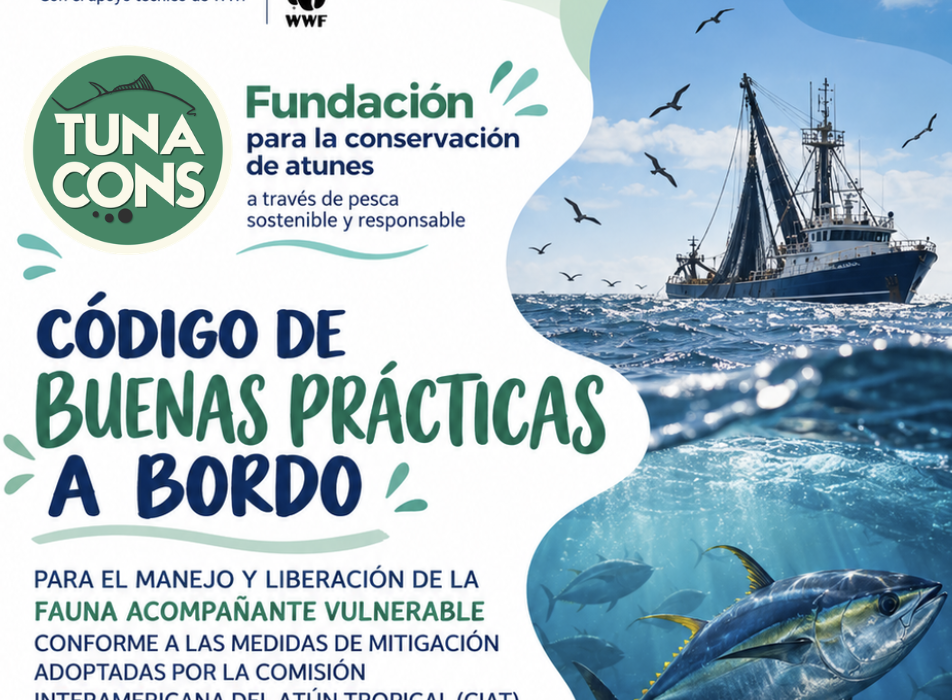
La actualización 2026 incorpora medidas para la protección de especies marinas vulnerables, el uso responsable de dispositivos agregadores de peces y el fortalecimiento de la recopilación de información científica.
La Fundación TUNACONS presenta la actualización de su Código de Buenas Prácticas a Bordo, un instrumento técnico y operativo que promueve una pesca atunera más responsable en el Océano Pacífico Oriental (OPO), mediante procedimientos orientados a reducir el impacto ambiental de las operaciones pesqueras.
Implementado originalmente en 2017, en el marco del Proyecto de Mejora Pesquera (FIP) de TUNACONS y desarrollado con el apoyo técnico del Fondo Mundial para la Naturaleza (WWF), este código establece directrices para las tripulaciones de los buques atuneros de cerco, alineadas con las medidas de conservación de la Comisión Interamericana del Atún Tropical (CIAT).
Protección de especies marinas vulnerables
Uno de los principales componentes del documento es la aplicación de procedimientos adecuados para el manejo y liberación de tiburones, tiburones ballena, mantarrayas, rayas y tortugas marinas que puedan interactuar incidentalmente con las operaciones de pesca.
Estas buenas prácticas buscan incrementar las posibilidades de supervivencia de las especies liberadas, priorizando en todo momento la seguridad de las tripulaciones.
Plantados no enmallantes y biodegradables
El código incorpora disposiciones para el uso responsable de dispositivos agregadores de peces (FADs), incluyendo la eliminación de materiales enmallantes y la transición hacia plantados construidos con materiales biodegradables, conforme a las resoluciones de la CIAT.
Asimismo, promueve la recuperación de dispositivos cuando sea técnica y operativamente factible, especialmente en zonas marino-costeras sensibles, como las islas Galápagos, para contribuir a la prevención de la contaminación marina.
Capacitación, monitoreo y mejora continua
La actualización también fortalece los compromisos relacionados con la formación permanente de capitanes y tripulantes, la recopilación de datos de capturas e interacciones con especies vulnerables y la verificación del cumplimiento de las buenas prácticas.
Mediante herramientas digitales de registro, programas de capacitación y mecanismos de seguimiento, TUNACONS busca mejorar la calidad de la información disponible para la investigación científica y la gestión sostenible de los recursos pesqueros.
Con esta actualización, la Fundación TUNACONS reafirma su compromiso con una industria atunera basada en la ciencia, la responsabilidad ambiental y la mejora continua de sus operaciones.
📄 Descarga el Código de Buenas Prácticas a Bordo de TUNACONS – Actualización agosto de 2026.
–
TUNACONS Updates Its Onboard Best Practices Code to Strengthen Sustainable Tuna Fishing
The 2026 update introduces measures to protect vulnerable marine species, promote responsible fish aggregating device management, and strengthen scientific data collection.
The TUNACONS Foundation has released an updated version of its Onboard Best Practices Code, a technical and operational framework designed to promote more responsible tuna fishing in the Eastern Pacific Ocean (EPO) by reducing the environmental impacts of fishing operations.
Originally introduced in 2017 as part of the TUNACONS Fishery Improvement Project (FIP), and developed with technical support from the World Wide Fund for Nature (WWF), the Code provides practical guidelines for tuna purse-seine vessel crews, consistent with conservation measures adopted by the Inter-American Tropical Tuna Commission (IATTC).
Protecting Vulnerable Marine Species
A key component of the Code is the implementation of appropriate handling and release procedures for sharks, whale sharks, manta rays, other rays, and sea turtles that may be incidentally encountered during fishing operations.
These best practices are intended to improve the survival prospects of released animals while ensuring that crew safety remains the highest priority.
Non-Entangling and Biodegradable FADs
The updated Code includes provisions for the responsible use of fish aggregating devices (FADs), including the elimination of entangling materials and the transition towards devices constructed with biodegradable materials, in accordance with IATTC resolutions.
It also encourages the recovery of FADs whenever technically and operationally feasible, particularly in environmentally sensitive coastal and marine areas such as the Galápagos Islands, helping to prevent marine pollution.
Training, Monitoring and Continuous Improvement
The update further strengthens commitments to ongoing training for captains and crew members, the collection of catch and vulnerable species interaction data, and the verification of compliance with onboard best practices.
Through digital reporting tools, training programmes and monitoring mechanisms, TUNACONS aims to improve the quality of information available for scientific research and sustainable fisheries management.
With this latest update, the TUNACONS Foundation reaffirms its commitment to a science-based tuna industry built on environmental responsibility and continuous operational improvement.
–
TUNACONS aktualisiert seinen Verhaltenskodex für bewährte Praktiken an Bord zur Förderung einer nachhaltigen Thunfischfischerei
Die Aktualisierung 2026 umfasst Maßnahmen zum Schutz gefährdeter Meeresarten, zum verantwortungsvollen Einsatz von Fischaggregationsgeräten und zur Verbesserung der wissenschaftlichen Datenerfassung.
Die TUNACONS-Stiftung stellt die aktualisierte Fassung ihres Verhaltenskodex für bewährte Praktiken an Bord vor. Dieses technische und operative Regelwerk soll eine verantwortungsvollere Thunfischfischerei im östlichen Pazifik fördern und die Umweltauswirkungen der Fischereiaktivitäten verringern.
Der Kodex wurde ursprünglich 2017 im Rahmen des Fischereiverbesserungsprojekts (Fishery Improvement Project, FIP) von TUNACONS eingeführt und mit fachlicher Unterstützung des World Wide Fund for Nature (WWF) entwickelt.
Er enthält praxisorientierte Vorgaben für die Besatzungen von Thunfisch-Ringwadenfängern und berücksichtigt die Erhaltungsmaßnahmen der Interamerikanischen Kommission für tropischen Thunfisch (IATTC/CIAT).
Schutz gefährdeter Meeresarten
Ein zentraler Bestandteil des Kodex sind geeignete Verfahren für den schonenden Umgang mit Haien, Walhaien, Mantarochen, anderen Rochen und Meeresschildkröten sowie deren sichere Freilassung, wenn diese Arten unbeabsichtigt mit den Fanggeräten in Kontakt kommen.
Diese Maßnahmen sollen die Überlebenschancen der freigelassenen Tiere verbessern. Dabei hat die Sicherheit der Besatzungsmitglieder stets oberste Priorität.
Nicht verfangende und biologisch abbaubare Fischaggregationsgeräte
Der aktualisierte Kodex enthält Bestimmungen für den verantwortungsvollen Einsatz von Fischaggregationsgeräten (Fish Aggregating Devices, FADs).
Dazu gehören der Verzicht auf Materialien, in denen sich Meerestiere verfangen können, sowie der schrittweise Übergang zu Konstruktionen aus biologisch abbaubaren Materialien gemäß den einschlägigen IATTC-Resolutionen.
Darüber hinaus fördert TUNACONS die Bergung solcher Geräte, sofern dies technisch und betrieblich möglich ist. Dies gilt insbesondere für ökologisch sensible Meeres- und Küstengebiete wie die Galápagosinseln, um zur Vermeidung von Meeresverschmutzung beizutragen.
Schulungen, Überwachung und kontinuierliche Verbesserung
Die Aktualisierung stärkt außerdem die Verpflichtungen zur regelmäßigen Schulung von Kapitänen und Besatzungsmitgliedern, zur Erfassung von Fangdaten und unbeabsichtigten Interaktionen mit gefährdeten Meeresarten sowie zur Überprüfung der Einhaltung bewährter Praktiken an Bord.
Mithilfe digitaler Erfassungssysteme, gezielter Schulungsprogramme und entsprechender Kontrollmechanismen möchte TUNACONS die Qualität der verfügbaren Daten verbessern und damit die wissenschaftliche Forschung sowie ein nachhaltiges Fischereimanagement unterstützen.
Mit dieser Aktualisierung bekräftigt die TUNACONS-Stiftung ihr Engagement für eine wissenschaftlich fundierte Thunfischfischerei, die ökologische Verantwortung und eine kontinuierliche Verbesserung der Betriebsabläufe miteinander verbindet.