
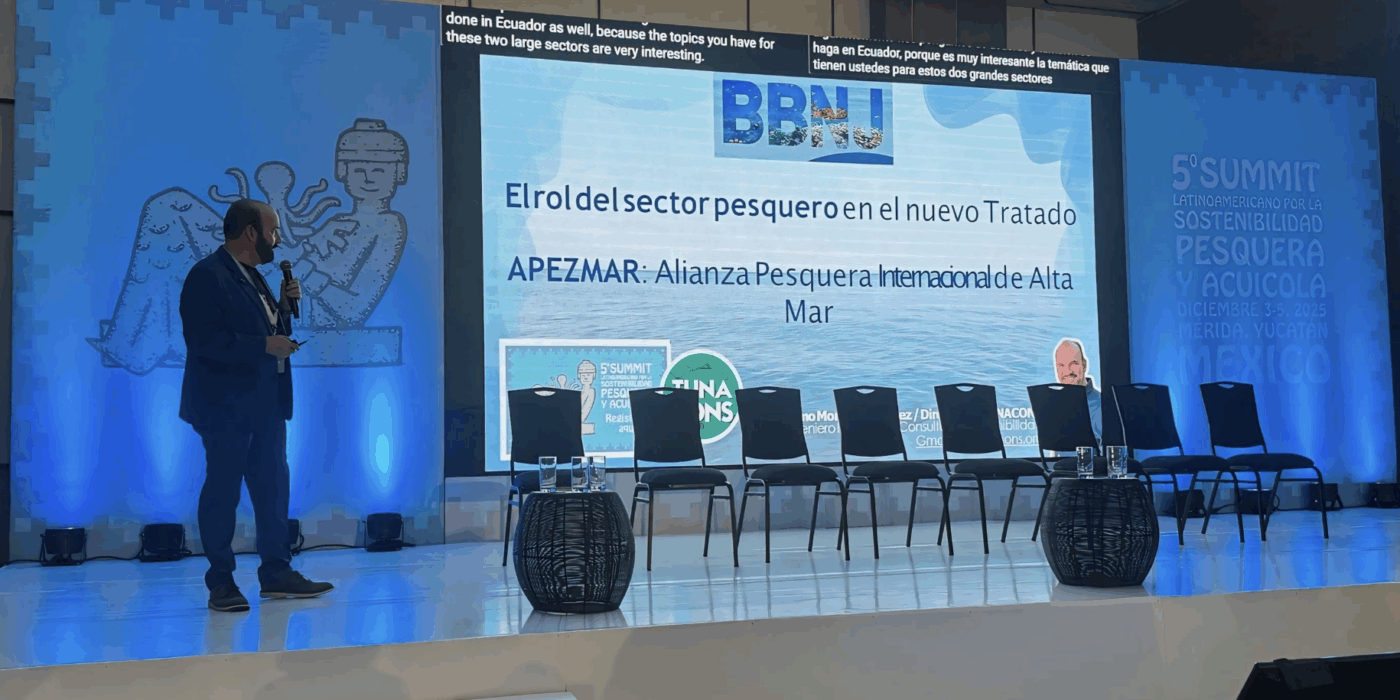
TUNACONS actively participated in the Fifth Latin American Summit on Fisheries and Aquaculture Sustainability, held in Mérida, Mexico—an event that brought together more than 500 representatives from 16 countries and featured over 150 speakers, including industry leaders, government authorities, NGOs, academia and international organizations.
Our Executive Director, Guillermo Morán Velásquez, took part in a panel addressing the BBNJ Treaty (Biodiversity Beyond National Jurisdiction) and the role of the fishing sector. He highlighted the importance of ensuring that any new measures in areas beyond national jurisdiction are grounded in robust science and are fully compatible with the regulations of the Regional Fisheries Management Organizations (RFMOs) such as IATTC, SPRFMO, WCPFC, CCAMLR, among others.
During his intervention, Morán emphasized that coordination with RFMOs must not be symbolic; it must be binding and technically sound to avoid duplication, unjustified restrictions, or negative socioeconomic impacts on fleets operating legally and under internationally recognized sustainability standards.
Key Proposal: An International High Seas Fisheries Alliance (APESMAR)
One of the most relevant contributions presented during the summit was the proposal to establish an International High Seas Fisheries Alliance (APESMAR)—a coordination mechanism among industrial and artisanal fishing organizations, universities, research centers, and companies involved in responsible fishing across all interested countries.
The objective of this Alliance should be to:
- Build a strong technical and legal position ahead of the first BBNJ COP.
- Ensure that implementation of the treaty recognizes the value of sustainable fishing and its role in global food security.
- Guarantee that any measures—such as the creation of high seas marine protected areas—are evaluated based on robust scientific evidence, while respecting RFMO decisions.
- Unite the voice of the global fishing sector to prevent misinterpretations or inadequate applications of the treaty.
This initiative, emerging from Ecuador, underscores the importance of an international governance framework that meaningfully includes the productive sector in key ocean-related decisions—especially those who work directly at sea and promote responsible fishing practices.
Our Commitment
From Ecuador, TUNACONS reaffirms its commitment to achieving a sustainable, transparent and science-based fishing activity, with constructive participation in all forums that will shape the future of ocean conservation and sustainable use. We firmly believe that well-managed, responsible, and science-driven fisheries are an essential part of the solution to protect marine biodiversity for current and future generations.
We will continue working for a healthier Pacific, a more sustainable tuna fishery, and an international governance framework that listens to those who live from—and care for—the sea.