world tuna day tunacons

Así celebra Ecuador el Día Mundial del Atún 2022 – How Ecuador celebrates World Tuna Day 2022

El Día Mundial del Atún se celebra cada 2 de mayo reconocida en diciembre del 2016 por la Asamblea de las Naciones Unidas para destacar la importancia de una gestión pesquera sostenible y de conservación que evite que las poblaciones de atún se reduzcan peligrosamente, reconocer también un papel fundamental en el desarrollo sostenible, la seguridad alimentaria, la economía y los medios de vida de las personas en todo el mundo.

El atún es una fuente de alimento para millones de personas, lo que ha motivado compartir con diferentes actores de la cadena del atún de Ecuador pero sobre todo la característica que causa una gran dinámica para su aprovechamiento es por ser hoy en día el mayor deleite culinario que genera su sabor y su fantástico contribución nutricional. Asistieron más de 60 representantes de la cadena atunera; armadores industriales, artesanales, proveedores, colaboradores, compradores, asesores, empresas de servicios entre otros., a una celebración anticipada de este importante día, ya que el lunes 2 de mayo es festivo por la conmemoración Día Internacional de los Trabajadores.

El evento se lleva a cabo con la finalidad para dar la relevancia necesaria sobre la variedad de platos y presentaciones que llevan a tener un gran consumo de atún en el Mundo, pero también en Ecuador. Más del 80% de las capturas ecuatorianas se exportan, con un valor estimado en más de 1.300 millones de dólares anuales siendo el tercer producto de exportación del país y el primero en productos industrializados (con valor agregado) según los datos del banco central del Ecuador, por eso es el deseo de los armadores atuneros industriales y artesanales que los ciudadanos ecuatorianos y del mundo conozcan las delicias que se pueden preparar con las diferentes especies de atunes, siendo proteína vital en nuestros alimentos, y que mejor oportunidad que el día en que el mundo entero reconoce a esta especie.

Ecuador es el primer productor de atunes tropicales en el Pacifico Oriental con su flota de cerco, el segundo exportador mundial de atunes procesados para la elaboración de enlatados, frascos, pouch, filetes entre otros que tiene sus mercados principales en la UE, Latinoamérica y USA, pero también es un importante productor en la región de atunes en estado ultracongelado y frescos que sirven para platos como sushi, sashimi, niguiri entre otros variados platos que son hoy de una riqueza inimaginable en el mundo de la cocina tradicional y gourmet. Así mismo, es un gran compromiso de todos los actores de la cadena trabajar permanente para que la pesquería alcance los más altos estándares técnicos y científicos para lograr una actividad sostenible y responsable.

Participaron en la organización del evento los socios de la Cámara Nacional de Pesquerías del Ecuador CNP y los miembros de la Fundación para la conservación de atunes TUNACONS. El evento se denominó “Almuerzo Gastronómico por el Día Mundial del Atún” y tuvo lugar en el Club de la Unión de la ciudad de Guayaquil. El chef ejecutivo del Club, Federico Trujillo Bejarano, preparó un menú de 14 platillos para degustación de todos los asistentes. El chef es de origen colombiano, pero residente en Ecuador, ha dirigido los banquetes y las galas de importantes personalidades de la política y del espectáculo como Russel Crowe, Meg Ryan, Álvaro Uribe, Fidel Castro, el Príncipe Felipe de Asturias, Christian Castro, Maná, Maluma, entre otros.

Para ampliar la información no dude en contactarnos. Emisor del boletín: Lcda. Mayi Zambrano V., Directora de comunicación de TUNACONS. Mzambrano@www.tunacons.org – 593 9 84814782 Material gráfico fotos/video disponible en alta definición: https://www.tunacons.org/diadelatun

World Tuna Day is celebrated every May 2, recognised in December 2016 by the United Nations Assembly to highlight the importance of sustainable fisheries management and conservation to prevent tuna stocks from declining dangerously, also recognising a fundamental role in sustainable development, food security, the economy and the livelihoods of people around the world. Tuna is a source of food for millions of people, which has motivated sharing with different actors of the Ecuadorian tuna chain but above all the characteristic that causes a great dynamic for its use is for being today the greatest culinary delight that generates its taste and its fantastic nutritional contribution.
More than 60 representatives of the tuna chain, industrial and artisanal shipowners, suppliers, collaborators, buyers, advisors, service companies, among others, attended an early celebration of this important day, since Monday, May 2nd is a holiday to commemorate International Workers’ Day.
The event is held in order to give the necessary relevance to the variety of dishes and presentations that lead to a large consumption of tuna in the world, but also in Ecuador. More than 80% of Ecuadorian catches are exported, with an estimated value of more than 1,300 million dollars per year, being the third export product of the country and the first in industrialized products (with added value) according to data from the central bank of Ecuador, so it is the desire of industrial and artisanal tuna shipowners that Ecuadorian citizens and the world know the delicacies that can be prepared with different species of tuna, being vital protein in our food, and what better opportunity than the day that the world recognizes this species.

Ecuador is the first producer of tropical tuna in the Eastern Pacific with its purse seine fleet, the second world exporter of processed tuna for canning, jars, pouch, fillets among others that has its main markets in the EU, Latin America and USA, but is also an important producer in the region of tuna in deep-frozen and fresh state that serve for dishes such as sushi, sashimi, niguiri among other varied dishes that are today of an unimaginable richness in the world of traditional and gourmet cuisine.
Likewise, it is a great commitment of all the actors in the chain to work permanently so that the fishery reaches the highest technical and scientific standards in order to achieve a sustainable and responsible activity.

Members of the National Chamber of Fisheries of Ecuador CNP and members of the Foundation for the conservation of tuna TUNACONS participated in the organisation of the event.
The event was called “Gastronomic Lunch for World Tuna Day” and took place at the Club de la Unión in the city of Guayaquil. The Club’s executive chef, Federico Trujillo Bejarano, prepared a menu of 14 dishes for all attendees to taste. The chef is of Colombian origin, but resident in Ecuador, and has directed the banquets and galas of important personalities of politics and show business such as Russel Crowe, Meg Ryan, Álvaro Uribe, Fidel Castro, Prince Felipe de Asturias, Christian Castro, Maná, Maluma, among others.

For further information, please do not hesitate to contact us.
Newsletter issuer: Lcda. Mayi Zambrano V., Communication Director of TUNACONS.
Mzambrano@www.tunacons.org – 593 9 84814782

Photo/video graphic material available in high definition:
https://www.tunacons.org/diadelatun

pesca de atun ecuador

DÍA MUNDIAL DEL ATÚN: CONOZCA 5 RAZONES PARA CONSUMIRLO – WORLD TUNA DAY: 5 REASONS WHY YOU SHOULD EAT IT

  • Las Naciones Unidas celebra cada 2 de mayo el “Día Mundial del Atún” con el objetivo de subrayar la importancia de una gestión sostenible en la pesca de esta especie.
  • Ecuador es el segundo productor de atún en el mundo, después de Tailandia.
  • NIRSA es una de las empresas más importantes del país que ha logrado posicionar a la industria pesquera de atún entre las más importantes del mundo, a propósito “Día Mundial del Atún”, comparte las razones de por qué consumir atún.

Mayo 2022.- Desde el año 2016 Naciones Unidas celebra cada 2 de mayo el “Día Mundial del Atún” con el objetivo de subrayar la importancia de una gestión sostenible en la pesca de esta especie, misma que es muy representativa para la industria pesquera del país, ya que el Ecuador es el segundo productor en el mundo, después de Tailandia. De acuerdo con cifras de la Federación Ecuatoriana de Exportadores (Fedexpor), este sector ha logrado triplicar su volumen de exportación durante los últimos 10 años.

NIRSA es una de las empresas más importantes del país que ha logrado posicionar a la industria pesquera de atún entre las más importantes del mundo pues se ha consolidado en la vitrina internacional hacia Norteamérica, Centroamérica, Sudamérica, la Unión Europea, Asia, entre otros, posicionando así su liderazgo en más de 35 países en el mundo como un referente en buenas prácticas de pesca. Cabe destacar que NIRSA es la empresa líder en exportación en relación con la cantidad de toneladas de atún.

A propósito “Día Mundial del Atún”, NIRSA se suma a esta celebración para destacar la importancia e impacto que tiene este alimento para la seguridad alimentaria, la nutrición de las personas, el cuidado del medio ambiente, la economía y desarrollo del país.

¿Por qué consumir atún? Conozca algunas razones:

  1. Al elegir productos que trabajan por una pesca sostenible, ayudas al cuidado del océano y sus recursos.

La pesca sostenible implica tener un stock saludable de peces en el mar, respetar los hábitats y garantizar que las personas, que dependen de la pesca, puedan mantener su medio de vida; en la actualidad cada vez son más los países, empresas, científicos y actores del sector quienes suman esfuerzos para realizar actividades pesqueras de manera sostenible.

Según la Cámara Nacional de Pesquería, Ecuador ha sido un país pionero en la implementación y el respeto a las prácticas y mejoras orientadas a la protección de especies vulnerables y a reducir al máximo la captura incidental. A continuación, algunas acciones que NIRSA ejecuta para garantizar la sostenibilidad del recurso pesquero.

  • NIRSA forma parte del Directorio de Pacto Global de las Naciones Unidas para promover principios entre ellos en temas de medioambiente.
  • NIRSA es miembro de la ISSF (INTERNATIONAL SEAFOOD SUSTAINABILITY FOUNDATION), fundación sin ánimo de lucro formada por las principales industrias de conservas de atún del mundo cuyo objetivo es hacer de la pesca del atún una actividad sostenible a largo plazo y sobre bases e investigaciones científicas, garantizando la salud de los stocks, reduciendo la captura incidental y promoviendo la salud del ecosistema marino.
  • NIRSA es miembro de Tunacons: Nuestro trabajo a través de la fundación para la pesca sostenible de atún, de la cual somos miembros fundadores, tiene como objetivo conseguir la certificación más alta en materia de sostenibilidad, la MSC (Marine Stewardship Council). Esta fundación empezó con un Programa del Mejoramiento Pesquero (FIP), actualmente participan siete importantes empresas atuneras que promueven además acciones para el cuidado marino como: Cooperación científica con la Comisión Interamericana del atún para mejorar las evaluaciones de esta especie, aplicación de un Código de buenas prácticas para el cuidado, manejo y liberación de especies vulnerables como tiburones, tortugas, mantarrayas que interactúan en la pesquería; así como la capacitación constante de la tripulación.
  • NIRSA apoya y ejecuta acciones alineadas al Objetivo de Desarrollo Sostenible #14 (Vida Submarina) que busca, al 2025, prevenir y reducir significativamente la contaminación marina de todo tipo.
  • NIRSA es la única compañía ecuatoriana dentro de una lista de 384 empresas a nivel mundial convocada a participar en calidad de observador en la Conferencia de las Naciones Unidas de 2022 para apoyar la implementación del objetivo de desarrollo sostenible #14.
  1. El atún es importante para la economía del Ecuador. El sector pesquero es uno de los más importantes generadores de empleo a escala nacional. Según cifras de la Cámara Nacional de Pesquería, más de 100.000 personas trabajan directamente en esta actividad. Durante el primer trimestre del presente año las exportaciones pesqueras sumaron un valor de $417,97 millones de dólares, superando en 9,11% el monto registrado en el primer trimestre del 2020. El país cuenta con la flota atunera más potente del Pacífico Oriental, tiene 116 embarcaciones, con una capacidad de 93.000 toneladas. De acuerdo con cifras de la Federación Ecuatoriana de Exportadores (Fedexpor), el aporte de este producto representa el 8% del total de ventas no petroleras.
  1. El atún es un alimento fundamental para la seguridad alimentaria. Según cifras compartidas por el Programa Mundial de Alimentos – World Food Programme (WFP), de las Naciones Unidas, se conoce que el 23.9% de la población del Ecuador presenta desnutrición crónica y que 1 de cada 4 niños tiene retraso en el crecimiento a nivel nacional. Por otra parte, la Organización de las Naciones Unidas para la Alimentación y Agricultura (FAO), afirma que Incluir pescado en la dieta puede frenar la desnutrición, debido a que el pescado es uno de los alimentos más nutritivos y saludables y su inclusión en las dietas escolares puede contribuir a reducir la desnutrición infantil.
  2. El atún es un súper alimento que contiene un alto número de nutrientes beneficiosos para tu salud. El atún es un alimento muy rico en proteínas de alto valor biológico y en ácidos grasos Omega-3, resulta ideal para disminuir el colesterol y los triglicéridos. Es por ello por lo que representa un buen aliado para luchar contra las enfermedades cardiovasculares. Entre algunos beneficios que otorga su consumo constan: reduce el riesgo de infarto en un 30%, disminuye la incidencia de artritis reumatoide y reduce el riesgo de demencia, bipolaridad, depresión y Alzheimer. Pese a la accesibilidad a este gran alimento, según un estudio realizado por investigadores de la ESPOL e IPIAP, se puede conocer que el consumo per cápita anual de Ecuador al año 2021 fue de 7.5 kg/año, cifra que se encuentra por debajo de la media mundial que es de 21,9 kg/p/a (FAO, 2020).
  1. Favorecen el proceso de aprendizaje en los niños y niñas. Para María Emilia Reyes, Asesora Nutricional de NIRSA, los pescados como el atún son considerados alimentos con grandes propiedades nutricionales porque contienen proteínas de alto valor biológico, son ricos en yodo, hierro magnesio, calcio y vitaminas A y D. Por otra parte, los pescados son uno de los alimentos más beneficiosos para el cerebro debido a que contienen una gran cantidad de ácidos grasos de la cadena de omega-3 como el EPA y DHA, mismos que favorecen los mecanismos psicológicos, estructurales y cardiovasculares del cuerpo. Además, facilitan las conexiones nerviosas, favoreciendo el aprendizaje y la memoria. Estos ácidos grasos son vitales para el desarrollo y el buen funcionamiento de cerebro, la memoria y la vista. Una dieta con suficiente omega-3 (pescados azules) y omega-6 (aceites vegetales como el de girasol) es vital para el desarrollo del cerebro y, por lo tanto, para la futura capacidad de aprender.

“Nuestra empresa está comprometida con la pesca sostenible, es la esencia de nuestro negocio y de nuestra cultura organizacional.  Los actores involucrados debemos propender a ejecutar nuestras actividades de una manera respetuosa con el medio ambiente y transparente con la sociedad con el objetivo de lograr un mejor mundo” argumentó Melissa Aguirre, Gerente de Asuntos Corporativos de NIRSA.

Al ser Ecuador un fuerte productor de atún es esencial que el recurso pesquero se proteja y se utilice adecuadamente con acciones que promuevan la pesca de una manera responsable y sostenible.

SOBRE NIRSA:

Fundada en 1957, Negocios Industriales Real Nirsa S.A cuenta con una exitosa trayectoria en el mercado nacional e internacional a través de su marca insigne Real. Nirsa es una empresa ecuatoriana considerada como una de las más importantes en la industria de alimentos del país, que se especializa en la captura, procesamiento y comercialización de especies marinas y de acuacultura. Con más de 60 años de experiencia y calidad, la empresa ha posicionado a la industria pesquera ecuatoriana de atún entre las más destacadas del mundo, consolidado su participación en mercados como: Estados Unidos, Centroamérica, Sudamérica, Unión Europea, Asia, entre otros, posicionando así su liderazgo en más de 30 países y siendo un referente al liderar buenas prácticas de pesca. Realizando considerables inversiones, su planta de producción se destaca por su impresionante infraestructura, además de contar con su propia empacadora y poseer la flota pesquera más grande del país de bandera ecuatoriana. Fieles a su propósito, NIRSA aporta al desarrollo del Ecuador, generando fuentes de trabajo directo a más de 5.000 familias, alcanzando así el TOP 10 de las empresas ecuatorianas que mayor empleo genera en el país.

Gabinete de prensa:

ATREVIA

María José Cruz mtobar@atrevia.com

Jessy Andrade jandrade@atrevia.com

⬇️⬇️⬇️⬇️⬇️

WORLD TUNA DAY: LEARN 5 REASONS TO EAT IT
(Photo caption): Reference photograph of a school of tuna.

The United Nations celebrates “World Tuna Day” every 2 May to highlight the importance of sustainable management of tuna fishing.
Ecuador is the second largest producer of tuna in the world, after Thailand.
NIRSA is one of the most important companies in the country that has managed to position the tuna fishing industry among the most important in the world, on the occasion of “World Tuna Day”, shares the reasons why to consume tuna.

May 2022 – Since 2016, the United Nations celebrates every May 2 the “World Tuna Day” with the aim of highlighting the importance of sustainable management in the fishing of this species, which is very representative of the country’s fishing industry, since Ecuador is the second largest producer in the world, after Thailand. According to figures from the Ecuadorian Federation of Exporters (Fedexpor), this sector has managed to triple its export volume over the last 10 years.

NIRSA is one of the most important companies in the country that has managed to position the tuna fishing industry among the most important in the world, as it has consolidated its position in the international showcase to North America, Central America, South America, the European Union, Asia, among others, thus positioning its leadership in more than 35 countries in the world as a benchmark in good fishing practices. It should be noted that NIRSA is the leading company in exports in relation to the number of tonnes of tuna.

On the occasion of “World Tuna Day”, NIRSA joins this celebration to highlight the importance and impact of this food on food security, people’s nutrition, environmental care, economy, and development of the country.

Why eat tuna? Here are some reasons:

By choosing products that work for sustainable fishing, you help to care for the ocean and its resources.
Sustainable fishing means having a healthy stock of fish in the sea, respecting habitats and ensuring that people, who depend on fishing, can maintain their livelihoods. Nowadays, more and more countries, companies, scientists and actors in the sector are joining forces to carry out fishing activities in a sustainable way.

According to the National Chamber of Fisheries, Ecuador has been a pioneer in implementing and respecting practices and improvements aimed at protecting vulnerable species and minimising bycatch. The following are some of the actions that NIRSA carries out to guarantee the sustainability of the fishing resource.

NIRSA is a member of the United Nations Global Compact Board of Directors to promote principles among them on environmental issues.
NIRSA is a member of the ISSF (INTERNATIONAL SEAFOOD SUSTAINABILITY FOUNDATION), a non-profit foundation formed by the world’s leading tuna canning industries whose objective is to make tuna fishing a long-term sustainable activity based on the scientific research, guaranteeing the health of stocks, reducing bycatch and promoting the health of the marine ecosystem.
NIRSA is a member of Tunacons: Our work through the Foundation for Sustainable Tuna Fisheries, of which we are a founding member, aims to achieve the highest sustainability certification, the Marine Stewardship Council (MSC). This foundation started with a Fishery Improvement Programme (FIP), currently involving seven major tuna companies that also promote actions for marine care such as: scientific cooperation with the Inter-American Tuna Commission to improve assessments of this species, implementation of a Code of Good Practice for the care, handling and release of vulnerable species such as sharks, turtles, manta rays that interact in the fishery, as well as the constant training of the crew.
NIRSA supports and executes actions aligned with Sustainable Development Goal #14 (Underwater Life) which seeks, by 2025, to prevent and significantly reduce marine pollution of all kinds.
NIRSA is the only Ecuadorian company in a list of 384 companies worldwide called to participate as an observer at the United Nations Conference in 2022 to support the implementation of Sustainable Development Goal #14.

Tuna is important for Ecuador’s economy. The fishing sector is one of the most important generators of employment at the national level. According to figures from the National Chamber of Fisheries, more than 100,000 people are directly employed in this activity. During the first quarter of this year, fishery exports totaled a value of $417.97 million dollars, 9.11% higher than the amount recorded in the first quarter of 2020. The country has the most powerful tuna fleet in the Eastern Pacific, with 116 vessels, with a capacity of 93,000 tonnes. According to figures from the Ecuadorian Federation of Exporters (Fedexpor), the contribution of this product represents 8% of total non-oil sales.

Tuna is a fundamental food for food security. According to figures shared by the United Nations World Food Programme (WFP), it is known that 23.9% of Ecuador’s population is chronically malnourished and that 1 in 4 children are stunted at the national level. On the other hand, the Food and Agriculture Organization of the United Nations (FAO) states that including fish in the diet can curb malnutrition because fish is one of the most nutritious and healthy foods and its inclusion in school diets can help reduce child malnutrition.
Tuna is a superfood that contains a high number of nutrients beneficial to your health. Tuna is rich in high-biological value proteins and Omega-3 fatty acids and is ideal for lowering cholesterol and triglycerides. This is why it is a good ally in the fight against cardiovascular diseases. Some of the benefits of its consumption include: it reduces the risk of heart attack by 30%, reduces the incidence of rheumatoid arthritis, and reduces the risk of dementia, bipolar disorder, depression and Alzheimer’s disease. Despite the accessibility of this great food, according to a study carried out by researchers from ESPOL and IPIAP, the annual per capita consumption in Ecuador in 2021 was 7.5 kg/year, which is below the world average of 21.9 kg/p/year (FAO, 2020).

They favour the learning process in children. For María Emilia Reyes, Nutritional Advisor at NIRSA, fish such as tuna are considered foods with great nutritional properties because they contain proteins of high biological value, are rich in iodine, iron, magnesium, calcium and vitamins A and D. Moreover, fish are one of the most beneficial foods for the brain because they contain a large number of fatty acids from the omega-3 chain such as EPA and DHA, which favour the body’s psychological, structural and cardiovascular mechanisms. They also facilitate nerve connections, promoting learning and memory. These fatty acids are vital for the development and proper functioning of the brain, memory and eyesight. A diet with sufficient omega-3 (oily fish) and omega-6 (vegetable oils such as sunflower oil) is vital for brain development and, therefore, for future learning ability.

“Our company is committed to sustainable fishing, it is at the core of our business and our organizational culture. As stakeholders we must strive to execute our activities in an environmentally friendly and transparent way with society in order to achieve a better world” argued Melissa Aguirre, Corporate Affairs Manager at NIRSA.

As Ecuador is a strong producer of tuna it is essential that the fishing resource is protected and properly utilized with actions that promote fishing in a responsible and sustainable manner.

ABOUT NIRSA:

Founded in 1957, Negocios Industriales Real Nirsa S.A has a successful track record in the national and international market through its flagship brand Real. Nirsa is an Ecuadorian company considered one of the most important in the country’s food industry, specializing in the capture, processing, and commercialization of marine and aquaculture species. With more than 60 years of experience and quality, the company has positioned the Ecuadorian tuna fishing industry among the most outstanding in the world, consolidating its participation in markets such as: the United States, Central America, South America, European Union, Asia, among others, thus positioning its leadership in more than 30 countries and being a benchmark by leading good fishing practices. Making considerable investments, its production plant stands out for its impressive infrastructure, in addition to having its own packing plant and owning the country’s largest Ecuadorian-flagged fishing fleet. True to its purpose, NIRSA contributes to the development of Ecuador, generating direct jobs for more than 5,000 families.

Social responsibility issues

Corporate social responsibility issues are at the forefront of the company’s priorities. Our members were trained by OSA International to introduce them to the field of certifications and we expect to have another training in the next semester to evaluate the application of this new knowledge. People are the best element the company has, and updating knowledge is key to ensure that the entire chain works efficiently”.

OSA provided ISO19011 training in Ecuador for TUNACONS, the Ecuadorian Tuna Conservation organisation made up of Ecuadorian fishing companies.

The training workshop detailed the importance of ISO19011:2018 for internal, second party or third-party audit. It informed participants about the entire audit process with a focus on audit in fisheries and at processing sites. This creates a shared understanding of the key elements in the audit process and the importance of auditors and assessors carefully using the steps in each audit process.

The training also addressed ISO19011:2018 aspects related to risk in auditing. This training is an important basis to underpin the development of seafood company social responsibility management systems and to improve the treatment of workers at sea.

http://www.osainternational.global/tunacons

Tunacons prueba “plantados” hechos de fibra de abacá – Tunacons test “FADS” made from abaca fiber.

En Ecuador (Suramérica) hay una organización gremial que representa los intereses de 7 grandes empresas dedicadas a la pesca del atún con fines comerciales. Se trata de Tunacons, nombre contraído de la expresión inglesa Tuna Conservation o, dicho en español, “conservación atunera”.

Nació como un proyecto corriente de pesquería sostenible, pero ante el apremio mundial por la preservación de las especies marinas muy amenazadas tuvo que transformarse en Fundación para la pesca sostenible de atún, conservando el nombre original.

Con esta última finalidad contrajo voluntariamente varios compromisos para cumplir a lo largo del año 2021 que acaba de terminar, entre ellos reemplazar el 20 % de los Dispositivos Agregadores de Peces (DAP), también conocidos como “plantados” -que normalmente son elaborados utilizando material sintético-, sustituyéndolos con versiones eco-amigables (EcoFAD) elaboradas a base de una fibra vegetal a la que suele llamarse cáñamo de manila o abacá, que desde hace algunos años es cultivada de forma extensiva en territorio ecuatoriano.

Plantado cosido con fibras de abacá. / FOTO: Tunacons / Ecuador

Acerca de los plantados

La pesquería de atún alrededor del mundo usa los “plantados” (también llamados FAD por sus siglas en inglés) como una herramienta útil para su actividad. En la jerga pesquera se los llama con ese nombre porque son anclados para flotar en un punto fijo del océano, donde generan sombra bajo la cual se amontonan muchos peces pequeños que sirven de carnada para atraer a los atunes, que aglomerados allí son capturados por los pescadores.

dav

A pesar de la iniciativa de uso de materiales degradables puesta en práctica por las flotas pesqueras de otros océanos, el compromiso formal de Tunacons, de usar EcoFAD, marca un hito que confirma el camino de la industria pesquera hacia prácticas más sostenibles.

La investigación sobre materiales degradables de origen vegetal lleva ya cuatro años en desarrollo. El equipo técnico de Tunacons ha realizado múltiples pruebas de resistencia de diversos materiales, incluyendo las conocidas fibras de cabuya y yute, pero se concluyó -como se lo evidencia en los videos del canal de YouTube de la Fundación- que el abacá es el más resistente ante la alcalinidad del agua de mar.

Prensado del tejido de abacá. / VIDEO: Tunacons / Ecuador

El próximo paso del proceso será realizar un monitoreo de los EcoFAD sembrados o “plantados”, para analizar su resistencia y niveles de captura, y luego continuar ampliando el despliegue de una mayor cantidad de este tipo de plantados.

Acerca de Tunacons

Guillermo Morán V. / FOTO: Tunacons

Con el liderazgo de Guillermo Morán Velasquez como director, Tunacons espera alcanzar, en el segundo trimestre de 2022, la primera certificación de Marine Stewardship Council (Consejo de Administración Marina) para la pesca responsable.

La Fundación está conformada por 5 miembros plenos, entre nacionales y extranjeros, a saber: Negocios Industriales Real, S.A.; Eurofish y Servigrup de Ecuador; Pesquera Jadran de Panamá y Trimarine de EEUU. También se unieron, el año recién pasado, 2 nuevos miembros adherentes que son Manacripex y Marbelize.

FUENTE: Tunacons (Guayaquil, Ecuador), mediante comunicado, fotos y video con firma de Mayi Zambrano V. (mzambrano@www.tunacons.org), quien los envió a REVISTA DE MANABÍ.

In Ecuador (South America) there is a trade organization that represents the interests of 7 large companies dedicated to commercial tuna fishing. It is Tunacons, a name contracted from the English expression Tuna Conservation or, in Spanish, “conservación atunera”.

It was born as an ordinary project for sustainable fisheries, but in view of the global pressure for the preservation of highly threatened marine species, it had to be transformed into the Foundation for Sustainable Tuna Fishing, keeping the original name.

With this last purpose, it voluntarily made several commitments to be fulfilled during the year 2021, which has just ended, including replacing 20% of the Fish Aggregating Devices (FAD), also known as “fad” -which are normally made using synthetic material-, replacing them with eco-friendly versions (EcoFAD) made from a vegetable fiber that is usually called manila hemp or abaca, which for some years has been extensively cultivated in Ecuadorian territory.

FAD sewn with abaca fibers / PHOTOGRAPH: Tunacons / Ecuador
About FADs
The tuna fishery around the world uses “FADs” (also called FADs) as a useful tool for its activity. In fishing jargon they are so called because they are anchored to float on a fixed point in the ocean, where they generate shade under which many small fish are piled up to serve as bait to attract tuna, which are caught by fishermen.

Despite the initiative to use degradable materials implemented by fishing fleets in other oceans, Tunacons’ formal commitment to use EcoFAD marks a milestone that confirms the fishing industry’s path towards more sustainable practices.

Research into degradable plant-based materials has been underway for four years. Tunacons’ technical team has conducted multiple resistance tests on various materials, including the well-known cabuya and jute fibers, but concluded – as evidenced in videos on the Foundation’s YouTube channel – that abaca is the most resistant to the alkalinity of seawater.


The next step in the process will be to monitor the EcoFADs to analyze their resistance and capture levels, and then continue to expand the deployment of a larger number of these types of plants.

About Tunacons

With the leadership of Guillermo Morán Velasquez as director, Tunacons expects to achieve, in the second quarter of 2022, the first Marine Stewardship Council certification for responsible fishing.

The Foundation is made up of 5 full members, among nationals and foreigners, namely: Negocios Industriales Real, S.A.; Eurofish and Servigrup from Ecuador; Pesquera Jadran from Panama and Trimarine from the USA. Two new adherent members, Manacripex and Marbelize, also joined last year.

SOURCE: Tunacons (Guayaquil, Ecuador), through a press release, photos and video signed by Mayi Zambrano V. (mzambrano@www.tunacons.org), who sent them to REVISTA DE MANABÍ.

‘Cuidando Galápagos’, iniciativa pesquera para la conservación integral – Caring for Galapagos’, a fisheries initiative for integrated conservation

La basura oceánica y la sobreexplotación pesquera están entre los principales factores que amenazan el equilibrio de los ecosistemas marinos en todo el mundo, en especial, de las zonas con alta riqueza faunística.

Tal es el caso del archipiélago de Galápagos y su reserva marina, donde viven más de 3.500 especies de animales y flora, registrados oficialmente. Por ello, la conservación de su naturaleza es una labor de las autoridades de Gobierno, oenegés y del sector privado.

A esta actividad se ha sumado decididamente una coalición de organizaciones del sector pesquero artesanal e industrial, que lanzaron la iniciativa ‘Cuidando Galápagos’.

El objetivo: reducir la contaminación marina a través de la recolección de basura oceánica y de plantados varados en alta mar, así como asistencia técnica para el manejo sostenible de las pesquerías artesanales en el archipiélago.

Para el desarrollo e implementación de la iniciativa se unieron el Grupo de Conservación del Atún (Tunacons), la Corporación de Organizaciones de Pesca Artesanal de Galápagos (Corpag), la Federación Nacional de Cooperativas Pesqueras del Ecuador (Fenacopec), la Cámara Nacional de Pesquería (CNP) y la Asociación de Atuneros del Ecuador (Atunec).

Guillermo Morán, gerente de Tunacons, explicó que el primer componente de ‘Cuidando Galápagos’ es recoger la basura del océano antes de que llegue a las islas y bajar el impacto que estos desechos generan en el ecosistema.

Según datos del Parque Nacional Galápagos, en 2021, se recolectaron 13 toneladas de desechos en las jornadas de limpieza que se realizaron en las playas, zonas de manglar y otros lugares de la provincia.

Por el lado de los plantados, que son sistemas de atracción de atún para facilitar su pesca, se estima que la flota atunera ecuatoriana utiliza entre 5.000 y 6.000 unidades al año, y que a Galápagos llegan menos del uno por ciento.

“Pero así sea pequeña la cantidad, vamos a trabajar para que la incidencia de los plantados sea cero”, aseguró Morán.

Para ejecutar este trabajo el aporte de los pescadores artesanales será fundamental, pues ellos se encargarán de recolectar la basura oceánica y los plantados en alta mar y también la basura submarina , explicó Juan Carlos Torres, presidente de la Corpag.

Los desechos se trasladarán hasta un centro de acopio y clasificación para reutilizar el material reciclable y hacer la disposición adecuada de los materiales que ya no se pueden usar. Por este, trabajo los pescadores recibirán un incentivo económico.

En Galápagos, hay alrededor de 700 pescadores artesanales activos, y están registradas 400 embarcaciones.

El rol de los armadores de barcos, que son parte de Tunacons, CNP y de Atunec, será reportar la presencia de los desechos antes de que entren a zonas cercanas a las islas, enviar las coordenadas y establecer una coordinación para la captación de los mismos .

El trabajo de recolección comenzará en marzo , luego de culminar la compra de equipos, la capacitación a los pescadores y definir la estrategia con las cooperativas de pescadores artesanales.

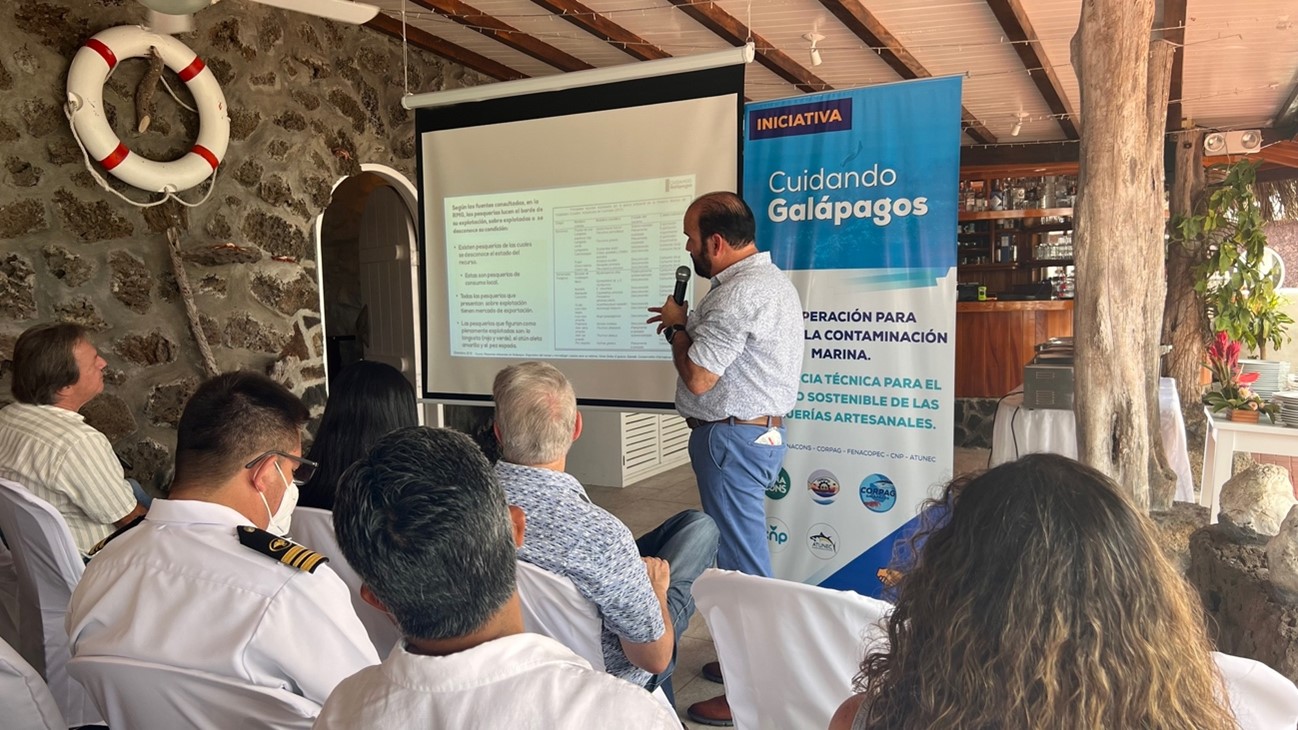
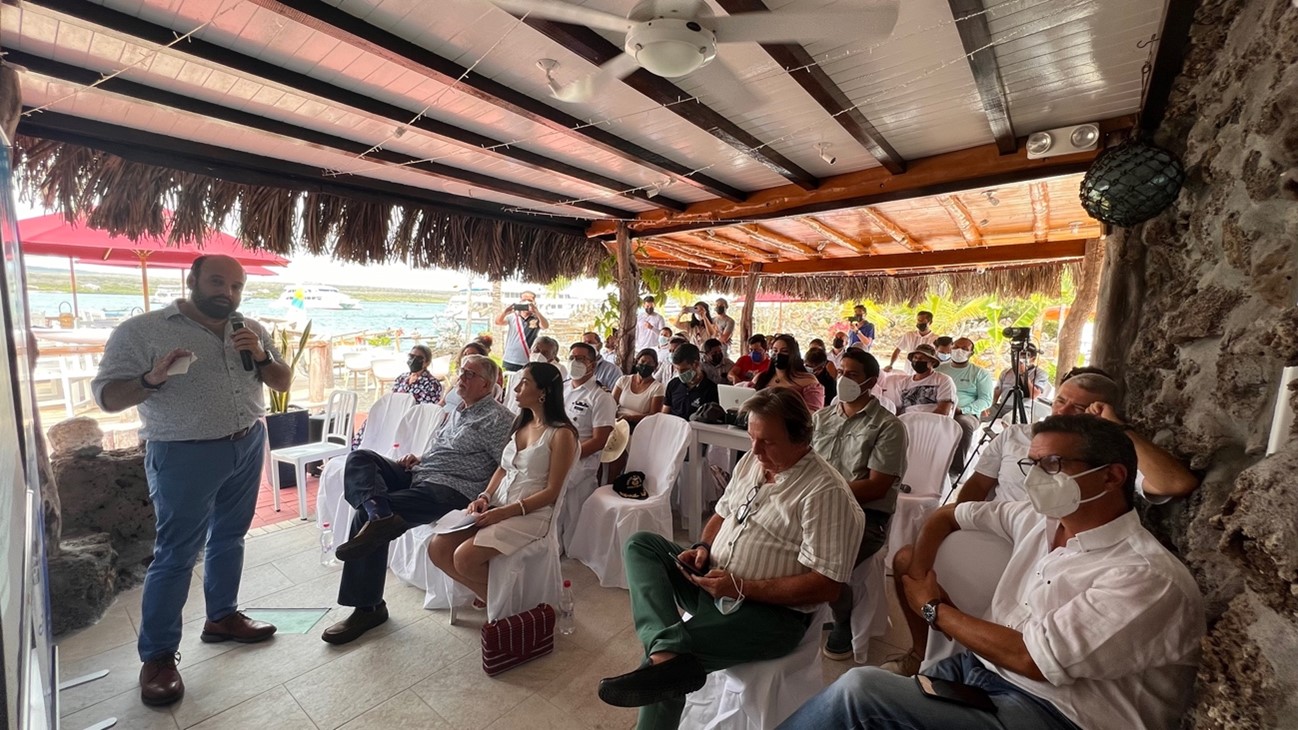
$!Guillermo Morán, gerente de Tunacons, explicó los componentes de la iniciativa en el lanzamiento de 'Cuidando Galápagos'.

Mejoramiento pesquero

El segundo componente de ‘Cuidando Galápagos’ es trabajar en proyectos de mejoramiento pesquero (FIP, por sus siglas en inglés) en las pesquerías donde actualmente falta información sobre su captura o no hay planes de manejo.

En la actualidad, solo las pesquerías de langosta y pepino de mar cuentan con medidas de ordenamiento para el cuidado de la especie en el archipiélago.

Pero hay otros recursos pesqueros como el langostino, pulpo, bacalao, guajo, lisa, etcétera, cuyo estado de la población es desconocido y por tal motivo no hay regulación pesquera.

Morán manifestó que la idea es trabajar en la creación de los FIP’s para la lograr una pesquería sostenible, para lo cual se necesita establecer sistemas de información y trazabilidad, estrategias de mejora competitivas enfocadas en eco eficiencia y que cuentan con una certificación.

Paralelamente, el sector pesquero debe trabajar de forma conjunta con el Parque Nacional Galápagos y la Subsecretaría de Recursos Pesqueros para establecer controles, monitoreos y sanciones a fin de lograr una buena administración de las pesquerías.

Dana Zambrano, subsecretaria de Recursos Pesqueros, expresó su respaldo a la iniciativa, de la cual espera que también se extienda hasta la generación de negocios para los pescadores. “Ahí vamos a dar nuestro apoyo, nuestra asesoría técnica en el fomento productivo”, agregó.

En todos los componentes de ‘Cuidando Galápagos’ se cuenta con el acompañamiento del Fondo Mundial para la Naturaleza (WWF), que brinda su asistencia técnica.

$!Guillermo Morán, gerente de Tunacons, explicó los componentes de la iniciativa en el lanzamiento de 'Cuidando Galápagos'.
galapagos tunacons


Ocean trash and overfishing are among the main factors threatening the balance of marine ecosystems around the world, especially in areas with high faunal richness.

Such is the case of the Galapagos archipelago and its marine reserve, home to more than 3,500 officially registered species of animals and flora. For this reason, the conservation of nature is a task for government authorities, NGOs, and the private sector.
A coalition of organizations from the artisanal and industrial fishing sector has joined in this activity, launching the ‘Caring for Galapagos’ initiative.
The objective: to reduce marine pollution through the collection of ocean garbage and FADs stranded in the high seas, as well as technical assistance for the sustainable management of artisanal fisheries in the archipelago.

The Tuna Conservation Group (Tunacons), the Corporation of Artisanal Fishing Organizations of Galapagos (Corpag), the National Federation of Fishing Cooperatives of Ecuador (Fenacopec), the National Chamber of Fisheries (CNP), and the Association of Tuna Farmers of Ecuador (Atunec) joined forces to develop and implement the initiative.

Guillermo Morán, manager of Tunacons, explained that the first component of “Caring for Galapagos” is to collect garbage from the ocean before it reaches the islands and reduce the impact that this waste has on the ecosystem.
According to data from the Galapagos National Park, in 2021, 13 tons of waste were collected in the cleanup days that took place on the beaches, mangrove areas and other places in the province.

As for FADs, which are systems for attracting tuna to facilitate their fishing, it is estimated that the Ecuadorian tuna fleet uses between 5,000 and 6,000 units per year, and that less than one percent arrive in Galapagos.

“But even if the amount is small, we are going to work so that the incidence of FADs is zero,” said Morán.

To carry out this work, the contribution of artisanal fishermen will be fundamental, since they will be in charge of collecting ocean garbage and FADs in the high seas, as well as underwater garbage, explained Juan Carlos Torres, president of Corpag.

The waste will be taken to a collection and classification center to reuse the recyclable material and properly dispose of the materials that can no longer be used. The fishermen will receive an economic incentive for this work.

There are approximately 700 active artisanal fishermen in Galapagos, and 400 boats are registered.
The role of the boat owners, who are part of Tunacons, CNP and Atunec, will be to report the presence of the waste before it enters areas near the islands, send the coordinates and establish coordination for the collection of the waste.


The collection work will begin in March, after the purchase of equipment, the training of fishermen and the definition of the strategy with the artisanal fishermen’s cooperatives.

Guillermo Morán, manager of Tunacons, explained the components of the initiative at the launch of ‘Caring for Galapagos’.
Fisheries improvement
The second component of ‘Caring for Galapagos’ is to work on fishery improvement projects (FIPs) in fisheries where there is currently a lack of catch information or management plans.

Currently, only the lobster and sea cucumber fisheries have management measures in place to protect the species in the archipelago.
But there are other fishery resources such as shrimp, octopus, cod, wahoo, mullet, etc., whose population status is unknown and for this reason there is no fishing regulation.

Morán said that the idea is to work on the creation of FIPs to achieve a sustainable fishery, for which it is necessary to establish information and traceability systems, competitive improvement strategies focused on eco-efficiency and that have a certification.
At the same time, the fishing sector must work together with the Galapagos National Park and the Undersecretary of Fisheries Resources to establish controls, monitoring and sanctions to achieve good fisheries management.

Dana Zambrano, Undersecretary of Fisheries Resources, expressed her support for the initiative, which she hopes will also extend to the generation of business for fishermen. “There we are going to give our support, our technical advice in productive development,” she added.

The World Wildlife Fund (WWF) provides technical assistance for all the components of “Caring for Galapagos”.

Taking care of Galapagos Iniciative Lauch

The initiative’s action plan contemplates 3 main axes,
1) Collection of FADs to avoid affecting the coastal areas of the islands.
2) Collection of garbage on the seabed.
3) Development of fishery improvement projects (FIPs) in artisanal fisheries in Galapagos.
 
The mechanism of this initiative of TUNACONS together with CNP and ATUNEC and the artisanal fishing guilds of Galapagos is a pioneer in the world because it generates an alliance between two fishing sectors.
 
This action in Ecuador paves the way for other fisheries in other parts of the world to develop it as well.
 

This is the original streaming of the event. Remember you can set subtitles in english on the youtube video settings.

video with simultaneous translation into English ⬇️

On Saturday, February 19th, 2022 the “Taking care of Galapagos” initiative was launched in Puerto Ayora, Santa Cruz, as a result of the Memorandum of Understanding for cooperation signed at the 3rd Ecuadorian Fisheries Summit.
The promoters and managers of the plan are:
Foundation for Sustainable Tuna Fishing TUNACONS,
Corporation of Artisanal Fishermen of Galapagos CORPAG,
Federation of Artisanal Fishing Cooperatives and Organizations of Ecuador FENACOPEC,  
National Chamber of Fisheries CNP, and
Asociación de Armadores del Ecuador ATUNEC
Although the incidence of FADs arriving off the coast of the Galapagos Islands is minimal, accounting for less than 1% of the FADs in the Ecuadorian fleet, the aim of this project is to reduce their presence completely.
 

The communication process will start with the captain of the Ecuadorian tuna vessel because 100% of the Ecuadorian tuna vessels are cooperating with this initiative. The captain notifies his fleet manager, who in turn notifies the project coordinator in Galapagos, who will coordinate with the Galapagos artisanal fishing cooperatives to mobilize a boat that will lift the FAD to take it to land where its materials will be sorted into recyclable and discarded.

The mechanism of this initiative of TUNACONS together with CNP and ATUNEC and the artisanal fishing guilds of Galapagos is a pioneer in the world because it generates an alliance between two fishing sectors.

This action in Ecuador paves the way for other fisheries in other parts of the world to develop it as well.

Regarding the collection of garbage on the seabed in the marine reserve, it is another example of support to reduce pollution, which is today the main threat to all oceans as highlighted by research published in Nature Sustainability, which provides the first integrated global diagnosis on the origin and composition of garbage dumped in the ocean.
On the surface of the sea, plastics make up 95% of the debris.  This is according to a new global study that puts figures on the composition of marine litter. Plastic is by far the dominant material in the oceans. The problem is well diagnosed. The bulk of the pollution is caused by single-use bags, bottles, food packaging, and food wrappings (Article from lavanguardia.com).  The process in this action will be to carry out periodic brigades of divers to collect coastal marine debris that will later be recycled or disposed of as appropriate.
 
The axis of technical advice for artisanal fishermen will focus on the design and implementation of “Fishery Improvement Projects” abbreviated FIPs for its acronym in English. This will allow them to have a clear and updated diagnosis of the current situation of the target species of their fishery through a pre-assessment of the fishery, then a plan of action to be implemented by the fishermen to achieve a sustainable fishing certification that will add value and open international markets to local fishermen.

The national fishing sector has joined together to collaborate in the care of the Galapagos and its marine areas as another act of responsibility for this treasure of humanity.

Galápagos GNPD and TUNACONS launch the “Caring for Galapagos” initiativeDPNG

This morning, Danny Rueda Córdova, director of the Galapagos National Park, and Guillermo Morán Velasquéz, executive director of the Tunacons Foundation, signed an inter-institutional cooperation agreement to launch the “Caring for Galapagos” initiative, which promotes coastal cleanup activities carried out by the environmental authority in the archipelago.
The Tunacons Foundation, together with local fishermen, will participate in the different coastal cleanup programs to collect ocean garbage from the marine ecosystems that is carried to the islands by currents, with the objective of contributing to the coastal cleanup of the archipelago, which collects an average of 12 tons of waste per year.

https://galapagos.gob.ec/dpng-y-tunacons-ponen-en-marcha-la-iniciativa-cuidando-galapagos/

Sector pesquero trabajará en proyectos para contrarrestar la contaminación marina en Galápagos – Fishing sector to work on projects to counteract marine pollution in Galapagos

La reducción de la contaminación en la Reserva Marina de Galápagos (RMG) y la capacitación y asistencia técnica para fortalecer la comercialización con base en la sostenibilidad son los ejes del memorando de entendimiento suscrito entre los sectores pesquero industrial, artesanal y el Ministerio de Producción, Comercio Exterior, Inversiones y Pesca.

Luego de la Cumbre Pesquera que se desarrolló el 23 y 24 de enero en Galápagos se definieron las bases de este memorando, que finalmente fue suscrito el viernes 29 de de enero con representantes del Ministerio de Producción. Como testigo de honor asistió Tarsicio Granizo Tamayo, director de WWF-Ecuador.

Eduardo Abudeye, director provisional de la Red de Pescadores de Galápagos, sostuvo que esto es fruto de un trabajo que empezó meses atrás con representantes de las empresas atuneras del continente y otras organizaciones para conseguir fondos para lograr tres objetivos: la recolección de basura marina, la creación de plantados ecológicos y asesoramiento técnico legal.

“Sobre la basura siempre realizamos esta actividad, pero ahora contaremos con la unión y el esfuerzo conjunto para mejorar las formas de realizar este trabajo”.

Guillermo Morán, director de Tunacons, añadió que se trata de unir esfuerzos entre gremios industriales y artesanales junto con el WWF, para contribuir con la recolección de basura marina y de aquellos plantados que llegan a la reserva marina y que afectan a las islas Galápagos; “se trata de trabajar en conjunto con los trabajadores locales para avisarles con tiempo que ha ingresado un plantado no ecológico”.

También es importante la asistencia técnica, sostuvo, para que el sector pesquero tenga un sistema de manejo sostenible de sus pesquerías, con sostenibilidad y capacitación para mejorar sus actividades y fortalecer su comercialización.

En el acto del viernes participaron Bruno Leone, de la Cámara Nacional de Pesquería; Ricardo Buehs, de la Asociación de Atuneros del Ecuador (Atunec); Gabriela Cruz, de la Federación de Cooperativas Pesqueras Artesanales del Ecuador (Fenacopec); y Guillermo Morán; director del Tuna Conservation Group (Tunacons).

Además, los presidentes de las cooperativas de Pesca de Galápagos: Juan Carlos Torres, de Copes Promar; Ricardo Castillo, de Copesan; Dionicio Zapata, de Copropag; Celso Villaroel, de Pelican Bay; Pablo Toro, de Copahisa;  el viceministro de Acuacultura y Pesca, Bernardo Hidalgo; y Tarsicio Granizo, director de WWF-Ecuador.

En el memorando se acordó trabajar por los próximos tres años en un proyecto de conservación cuyo objetivo es reducir la contaminación en la reserva marina de Galápagos provocada por basura que proviene de las zonas costeras y marinas, sobre todo la recolección de los dispositivos utilizados en la pesca atunera denominado plantados, que contribuyen a la mortalidad de especies que son parte de esta área protegida.

También se articulará la cooperación para brindar asistencia técnica y científica que mejore el manejo y la conservación de las pesquerías de Galápagos.

Finalmente se apoyará a las cooperativas locales para que alcancen estándares de sostenibilidad, con el desarrollo de buenas prácticas de conservación, manipulación y trazabilidad, que sirvan de base para fomentar la comercialización de productos pesqueros sostenibles. (I)

The reduction of pollution in the Galapagos Marine Reserve (GMR) and training and technical assistance to strengthen marketing based on sustainability are the cornerstones of the memorandum of understanding signed between the industrial and artisanal fishing sectors and the Ministry of Production, Foreign Trade, Investment and Fisheries.

After the Fishing Summit that took place on January 23 and 24 in Galapagos, the bases of this memorandum were defined, which was finally signed on Friday, January 29 with representatives of the Ministry of Production. Tarsicio Granizo Tamayo, director of WWF-Ecuador, was a witness of honor.

Eduardo Abudeye, provisional director of the Galapagos Fishermen’s Network, said that this is the result of work that began months ago with representatives of the tuna companies of the continent and other organizations to raise funds to achieve three objectives: the collection of marine garbage, the creation of ecological FADs and legal technical advice.

“On garbage we always carry out this activity, but now we will count on the union and the joint effort to improve the ways to carry out this work.”

⬇️⬇️⬇️⬇️⬇️

Guillermo Morán, director of Tunacons, added that the idea is to unite efforts between industrial and artisanal associations along with WWF to contribute to the collection of marine garbage and FADs that reach the marine reserve and affect the Galapagos Islands.

Technical assistance is also important, he said, so that the fishing sector has a sustainable management system for its fisheries, with sustainability and training to improve their activities and strengthen their marketing.

Bruno Leone, from the National Chamber of Fisheries; Ricardo Buehs, from the Association of Tuna Farmers of Ecuador (Atunec); Gabriela Cruz, from the Federation of Artisanal Fishing Cooperatives of Ecuador (Fenacopec); and Guillermo Morán, director of the Tuna Conservation Group (Tunacons) participated in Friday’s event.

Also present were the presidents of the Galapagos fishing cooperatives: Juan Carlos Torres, of Copes Promar; Ricardo Castillo, of Copesan; Dionicio Zapata, of Copropag; Celso Villaroel, of Pelican Bay; Pablo Toro, of Copahisa; the Vice Minister of Aquaculture and Fisheries, Bernardo Hidalgo; and Tarsicio Granizo, director of WWF-Ecuador.

The memorandum agreed to work for the next three years on a conservation project aimed at reducing pollution in the Galapagos marine reserve caused by garbage from coastal and marine areas, especially the collection of devices used in tuna fishing called FADs, which contribute to the mortality of species that are part of this protected area.

Cooperation will also be coordinated to provide technical and scientific assistance to improve the management and conservation of Galapagos fisheries.

Finally, support will be provided to local cooperatives to help them achieve sustainability standards through the development of good conservation, handling and traceability practices that will serve as a basis for promoting the marketing of sustainable fishery products. (I)

Socios de TUNACONS alcanzan el compromiso de reemplazar los plantados por “EcoFADs” – TUNACONS partners reach commitment to replace FADs with “EcoFADs”.

El compromiso de reemplazar el 20% de los Dispositivos Agregadores de Peces (DAPs), también llamados ´plantados´ (normalmente elaborados de material sintético) por los “EcoFADs”, versión eco-amigable a base de cáñamo de manila o abacá, fibra vegetal cultivada en Ecuador, fue alcanzado por la flota de barcos atuneros de las empresas fundadoras de TUNACONS.

La pesquería de atún alrededor del mundo, usa los plantados (FADs por sus siglas en inglés) como una herramienta útil para su actividad. Estos son objetos flotantes, naturales o artificiales, que los pescadores utilizan para atraer peces y facilitar su captura. El uso de esta herramienta resultó ser un método altamente efectivo para la captura del atún y para reducir costos operativos.

En la pesquería del atún tropical con red de cerco, el uso de los plantados a partir de la década de los 90´s ha generado mucha presión sobre las poblaciones de atunes juveniles y de otras especies marinas (fauna acompañante), en especial especies consideradas vulnerables (tiburones, tortugas marinas, rayas, etc.), por lo que se ha convertido en una preocupación de gestión cada vez más importante.

La iniciativa de usar materiales degradables en las flotas de otros océanos, impulsa el compromiso formal de TUNACONS en usar los EcoFADs para llevar a la industria pesquera hacia prácticas mas sostenibles.

La investigación sobre materiales degradables de origen vegetal lleva cuatro años en desarrollo. El equipo técnico de TUNACONS ha realizado múltiples pruebas de resistencia de diversos materiales, incluídas las conocidas cabuya y yute pero se concluyó, que el abacá es el más resistente ante la alcalinidad del agua de mar.

Los próximos pasos del proceso, serán realizar un monitoreo de los ECOFADs sembrados para analizar su resistencia y niveles de captura, para luego continuar ampliando el despliegue de una mayor cantidad de este tipo de Plantados.

TUNACONS empezó como un proyecto sostenible, pero su compromiso a largo plazo, la llevó a formarse como Fundación. que espera alcanzar la primera certificación Marine Stewardship Council para la pesca responsable para el segundo trimestre de 2022.

La Fundación está conformada por 5 miembros plenos entre nacionales y extranjeros; Negocios Industriales Real S.A., Eurofish y Servigrup de Ecuador, Pesquera Jadran de Panamá y Trimarine de EEUU. También se unieron el año pasado 2 nuevos miembros adherentes que son Manacripex y Marbelize.


The commitment to replace 20% of the Fish Aggregating Devices (FADs), also called ‘FADs’ (usually made of synthetic material) by the “EcoFADs”, an eco-friendly version based on manila hemp or abaca, a vegetable fiber grown in Ecuador, was achieved by the fleet of tuna vessels of the founding companies of TUNACONS.

The tuna fishery around the world uses FADs as a useful tool for its activity. These are floating objects, natural or artificial, that fishermen use to attract fish and facilitate their capture. The use of this tool proved to be a highly effective method for catching tuna and reducing operating costs.

In the tropical tuna purse seine fishery, the use of FADs since the 1990’s has generated a lot of pressure on juvenile tuna populations and other marine species (accompanying fauna), especially species considered vulnerable (sharks, sea turtles, rays, etc.), which has become an increasingly important management concern.

The initiative to use degradable materials in other ocean fleets drives TUNACONS’ formal commitment to use EcoFADs to move the fishing industry towards more sustainable practices.

Research on degradable plant-based materials has been under development for four years. The TUNACONS technical team has conducted multiple resistance tests on various materials, including the well-known cabuya and jute, but concluded that abaca is the most resistant to the alkalinity of seawater.

The next steps in the process will be to monitor the ECOFADs deployed to analyze their resistance and capture levels, and then continue to expand the deployment of a greater number of this type of FAD plants.

TUNACONS began as a sustainable project, but its long-term commitment led it to form a Foundation, which hopes to achieve the first Marine Stewardship Council certification for responsible fishing by the second quarter of 2022.

The Foundation is made up of 5 full members among nationals and foreigners; Negocios Industriales Real S.A., Eurofish and Servigrup from Ecuador, Pesquera Jadran from Panama and Trimarine from the USA. Two new adherent members, Manacripex and Marbelize, also joined last year.

Iniciativa de la industria pesquera ecuatoriana para reducir la contaminación marina – Ecuadorian fishing industry initiative to reduce marine pollution

Feb 23, 2022 | Blog

El día sábado 19 de febrero se realizó en Puerto Ayora, Santa Cruz el lanzamiento de la iniciativa «Cuidando Galápagos» fruto del Memorandum de entendimiento para la cooperación que se firmó en la 3ra Cumbre Pesquera del Ecuador.

 Los impulsadores y gestores del plan son:

Fundación para la pesca sostenible de atún TUNACONS,

Corporación de Pescadores Artesanales de Galápagos CORPAG,

Federación de Cooperativas y Organizaciones Pesqueras Artesanales del Ecuador FENACOPEC,

Cámara Nacional de Pesquerías CNP, y

Asociación de Armadores del Ecuador ATUNEC

El plan de acción de la iniciativa contempla 3 ejes principales,

1) Recolección de plantados para evitar afectar zonas costeras a las Islas

2) Recolección de basura en fondos marinos

3) Desarrollo de proyectos de mejora pesquera (FIPs) en pesquerías artesanales de Galápagos.

A pesar de que la incidencia de plantados que llegan a las costas de las Islas Galápagos es mínima, siendo menos del 1% de los plantados de la flota ecuatoriana, lo que se pretende con este proyecto es reducir su presencia por completo.

El proceso de comunicación será desde el capitán del barco atunero ecuatoriano, porque el 100% de los buques atuneros del ecuador está cooperando con esta iniciativa. El capitán notifica a su jefe de flota y este a su vez al coordinador del proyecto en Galápagos, quién coordinara con las Cooperativas pesqueras artesanales de Galápagos para movilizar una lancha que hará el levantamiento del plantado para llevarlo a tierra donde sus materiales serán clasificados en reciclables y desechados.

El mecanismo de esta iniciativa de TUNACONS junto con CNP y ATUNEC y los gremios pesqueros artesanales de Galápagos es pionera en el mundo porque genera una alianza entre dos sectores de la pesca, esta acción en Ecuador abre camino para que otras pesquerías en otras partes del mundo puedan desarrollarlo también.

Respecto a la recolección de basura en fondos marinos en la reserva marina, es otro ejemplo de apoyo para reducir de contaminación, que es hoy en día la principal amenaza de todos los océanos como lo destaca una investigación publicada en Nature Sustainability, que proporciona el primer diagnóstico global integrado sobre el origen y composición de la basura vertida en el océano.

En la superficie del mar los plásticos son el 95% de los desechos.  Así lo indica un nuevo estudio de escala mundial que pone cifras a la composición de la basura marina. El plástico es, de lejos, el material dominante en los océanos. El problema está perfectamente diagnosticado. El grueso de la contaminación lo causan las bolsas de un solo uso, las botellas, los envases de comida y los envoltorios alimentarios (Artículo de lavanguardia.com).  El proceso en esta acción será realizar brigadas periódicas de buzos para recoger la basura marina costera que posteriormente será reciclada o desechada según amerite.

El eje de asesorías técnicas para los pescadores artesanales se enfocará en el diseñar e implementar «Proyectos de Mejora pesquera» abreviados FIPs por sus siglas en inglés. Que les permitirá tener un diagnóstico claro y actualizado de la situación actual de la especie objetivo de su pesca a través de una preevaluación de la pesquería, posteriormente se traza un plan de acción que deben implementar los pescadores para alcanzar una certificación de pesca sostenible que dará un valor agregado y  abrirá mercados internacionales a los pescadores locales.

El sector pesquero nacional se ha unido para colaborar en el cuidado de Galápagos y sus zonas marinas como otro acto de responsabilidad con este tesoro de la humanidad.

​El evento fue transmitido en directo por las redes sociales de TUNACONS y el Media Partner Azul Sostenible. En el video de YouTube del evento, se puede ver la transmisión en español y por configuración automática se puede poner subtítulos en cualquier idioma. https://www.youtube.com/watch?v=C5VmxMR9R38&t=21s​

Para más información de la cooperación entre gremios pesqueros y acciones sostenibles en las Islas Galápagos, les invitamos a revisar nuestra web oficial.

https://www.tunacons.org/galapagos-cooperation/Presentación del Plan de acción

On Saturday, February 19, the “Caring for Galapagos” initiative was launched in Puerto Ayora, Santa Cruz, as a result of the Memorandum of Understanding for cooperation signed at the 3rd Ecuadorian Fisheries Summit.

The promoters and managers of the plan are:

Foundation for Sustainable Tuna Fishing TUNACONS,

Corporation of Artisanal Fishermen of Galapagos CORPAG,

Federation of Artisanal Fishing Cooperatives and Organizations of Ecuador FENACOPEC,

National Chamber of Fisheries CNP, and

Ecuadorian Shipowners Association ATUNEC

The plan of action of the initiative includes 3 main axes,

1) Collection of FADs to avoid affecting the coastal areas of the islands.

2) Collection of garbage on the seabed.

3) Development of fishery improvement projects (FIPs) in artisanal fisheries in Galapagos.

Although the incidence of FADs arriving off the coast of the Galapagos Islands is minimal, being less than 1% of the FADs in the Ecuadorian fleet, the aim of this project is to reduce their presence completely.

The communication process will be from the captain of the Ecuadorian tuna vessel, because 100% of the Ecuadorian tuna vessels are cooperating with this initiative. The captain notifies his fleet manager, who in turn notifies the project coordinator in Galapagos, who will coordinate with the Galapagos artisanal fishing cooperatives to mobilize a boat that will lift the FADs and take them to land where their materials will be sorted into recyclable and discarded.

The mechanism of this initiative of TUNACONS together with CNP and ATUNEC and the artisanal fishing guilds of Galapagos is a pioneer in the world because it generates an alliance between two fishing sectors, this action in Ecuador opens the way for other fisheries in other parts of the world to develop it as well.

Regarding the collection of garbage on the seabed in the marine reserve, it is another example of support to reduce pollution, which is today the main threat to all oceans, as highlighted by research published in Nature Sustainability, which provides the first integrated global diagnosis of the origin and composition of garbage dumped in the ocean.

At the surface of the sea, plastics account for 95% of the debris. This is according to a new global study that puts figures on the composition of marine litter. Plastic is by far the dominant material in the oceans. The problem is well diagnosed. The bulk of the pollution is caused by single-use bags, bottles, food packaging and food wrappings (Article from lavanguardia.com). The process in this action will be to carry out periodic brigades of divers to collect the coastal marine garbage that will later be recycled or disposed of as appropriate.

The axis of technical advice for artisanal fishermen will focus on designing and implementing “Fisheries Improvement Projects” abbreviated FIPs for its acronym in English. This will allow them to have a clear and updated diagnosis of the current situation of the target species of their fishery through a pre-assessment of the fishery, then a plan of action to be implemented by the fishermen to achieve a sustainable fishing certification that will add value and open international markets to local fishermen.

The national fishing sector has united to collaborate in the care of Galapagos and its marine areas as another act of responsibility towards this treasure of humanity.

The event was broadcast live on the social networks of TUNACONS and Media Partner Azul Sostenible. In the YouTube video of the event, you can see the transmission in Spanish and by automatic configuration you can put subtitles in any language. https://www.youtube.com/watch?v=C5VmxMR9R38&t=21s

For more information on cooperation between fishing guilds and sustainable actions in the Galapagos Islands, we invite you to review our official website.

Proudly powered by Wpopal.com